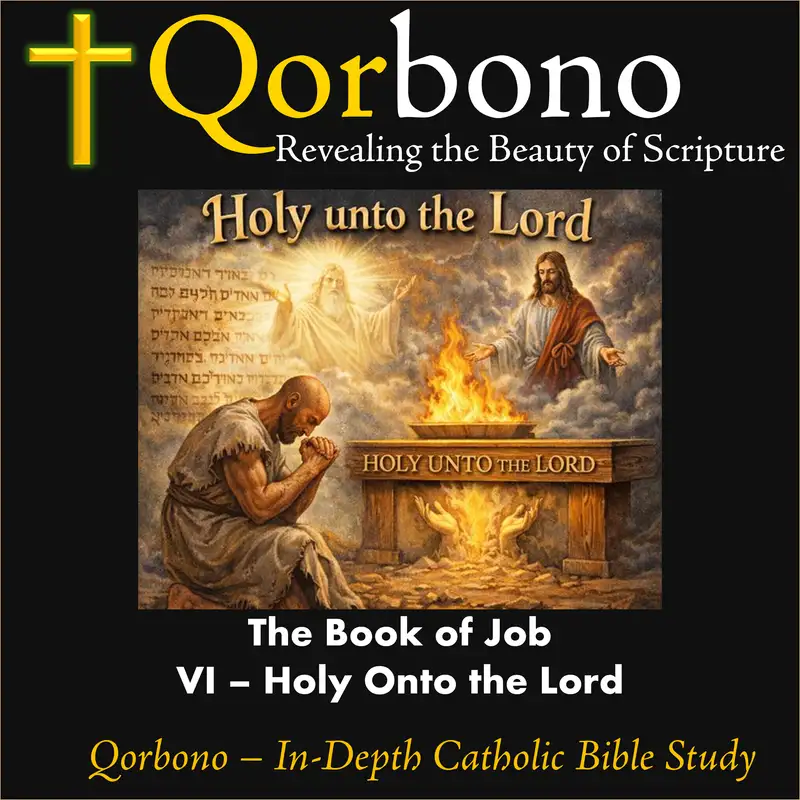
06 - Holy Onto the Lord
00:00
So today we're going to close this Bible study on the book of Job. As I told you last time, there were a bunch of thoughts that I captured as I did the study when I thought I would do it in four lectures and in end up being sufficiently interesting and I thought I would share it with you. So what we're going to do again is now focus on one aspect of the book which is holiness. So holy unto the Lord. And like I told you last time,
00:33
There's been some delays in posting the studies, but we will do that after, and I will send it through the mailing list to let you know that the three last studies are up and available. So if you haven't yet, you can subscribe to the newsletter that I showed you a little earlier. Go to corbono.com and just subscribe to the newsletter. Email and name would be sufficient.
01:00
Yeah, and then sorry, grab the QR code if you want to ask questions as usual. Otherwise you can ask them at the end. It is actually Job 6, not 5 in case you want to actually type the code. I didn't update that. And the last bit, again I'll remind you, is that next year starting somewhere in January we will essentially focus on the Gospel of St. John. It'll be a 15 lecture study.
01:28
of the Gospel of St. John and hopefully you guys can join us for that study. Yes. The same temple every other week, yes. And we uh will publish the schedule as we get closer. So please stand up and let's begin with a word of prayer as we always do. In the name of the Father, of the Son, the Holy Spirit, Amen. Come Holy Spirit.
01:57
fill the hearts of your faithful and kindle in them the fire of your love, send forth your spirit and I shall be created and you shall renew the face of the earth. O God, who by the light of the Holy Spirit did instruct the hearts of the faithful, grant that by the same Holy Spirit, we may be truly wise and ever enjoy his consolations through Christ our Lord. Amen. Mary, seed of wisdom.
02:26
In the name of the Father, of the Son, of the Holy Spirit, Please be seated. So what we'll cover today, five topics. The first one, a truncated view of God's will, we'll finish the conversation we had last time about God's will, permissive and perfect. And then I want to dive in a few elements that I think are...
02:51
are really interesting and important. And I'm really glad that you joined me today because they really form the sort of conclusion of this whole study. The poetry in the Book of Job, in case you wanted to read the book on your own, I'd like to offer you few suggestions how to deal with the poetry because the whole book, for the most part, aside from the prologue and the conclusion, is written as a poem. And then um there is a really interesting aspect.
03:18
in the book of Job that relates to the Our Father, which is that one petition in the Our Father, which I think many people struggle with, lead us not into temptation. um How do we look at that petition in the light of the book of Job and his trials? I'll also want to touch on um the counsel that Job's wife gave him and talk a little bit more about that. And finally,
03:46
Job's Holiness, which is going to be the crux of this study tonight. So, let's look again at that truncated view of God's will, the way we look at it, and we're look at it from the pastoral problem. I hinted at it last time, I just want to go in a little bit more. So, many of us do fall into comforting but distorted dualism, like I told you last time, and it bears repeating. If something good happens to us,
04:15
we consider it as part of God's sovereign will. This is what God wants for us, and it just happened. So intuitively, or almost instinctively, we attribute to God all good things that happened to us, and we attribute it to His sovereign will. That's what God wants. Without even questioning that.
04:38
Likewise, when something happens to us which is not good, obviously since God is good, can be something you want it, therefore we attribute it to his permissive will. And then we struggle with that. This dualism is precisely what the book of Job is deconstructing.
05:04
Why? Because this view turns God into, a well-meaning spectator of evil. Well, God allows evil, but he sort of sits back and let it happen.
05:17
What kind of, if you think about it from a psychological standpoint, from your sense of self, from your sense of security, how secure would you be with a God that allows evil and sits back and let it happen?
05:37
I don't think you'll be very secure. That's the struggle a lot of people have. Why would God allow that? If God loves me, why does He allow that to happen to me? And now we question God's intent, we question His will, we question His power.
05:57
and we're not even aware that we've basically painted ourselves into a corner and we painted God into a box.
06:07
God is obviously less than omnipotent because he's allowing this evil to happen. He can't stop it. So he can't be all powerful. That's what most people say. If God exists and God is all good, why does he allow evil? That question is rooted in this dualism.
06:25
And then finally it looks like God is a little bit schizophrenic. It's like there is the perfect will of God that wants good and then there's passive will of God that kind of allows evil and God really doesn't know what he wants to do. So we end up with a very confusing God, a very weak God and certainly not the God of the Bible.
06:47
The pastoral consequence to all of this is that believers lose both trust and holy fear. You can't trust God for everything that happens to you and therefore you're not going to fear him because you know God is like a gentle kitten that you know gives us good stuff, good vibes but then bad things happen and then has nothing to do with it. Why would you fear a gentle kitten? And the fear of the Lord
07:16
is the beginning of wisdom.
07:21
God becomes a gentle but powerless observer rather than the Lord of history.
07:29
And we end up in what I call soft heresy.
07:36
This is heretical.
07:41
And as God said in the book, they have not spoken rightly of me. When we fall into this dualism, we cannot speak rightly of God.
07:51
That is why this is a problem.
07:55
So, the first thing we need to understand is God has one will.
08:03
And there aren't two gods. There is the good God and the permissive God. It's one will. It's God's will all the time at every moment of your life. Whether perfect or permissive, it is the one same will. Think of it this way. If you have doubts about what I'm saying...
08:22
God's perfect will must allow his permissive will.
08:31
God's perfect will must allow His permissive will. Therefore, it's one. There is no contradiction in God.
08:43
Theology, the Catholic Church teaches that God's will is one, good and efficacious. What God wants will happen. Sovereign and permissive are not moral categories. Sovereign is not good, permissive, bad. Good, bad are moral categories. We have to stop thinking about sovereign and permissive in moral terms. They are distinctions
09:13
of the same divine act. Whether permissive or perfect, God is acting. And it's distinction in the way he's acting. But it is one God, and it is always for his greater glory.
09:33
Now, note.
09:36
This is where you have to exercise the virtue of piety. Piety is this virtue which ranks under justice, where you give God his due. It doesn't come naturally. You must exercise it. What I'm telling you doesn't come naturally. You have to train yourself to look at the world this way.
10:06
in small things and in big things.
10:12
So you can reorient your understanding and your thinking of God towards one will.
10:20
that brings about his glory. See, that's the distinction. It's one will, it brings his glory, not yours.
10:32
God is not acting primarily for our benefit.
10:39
That's a secondary cause. His primary act is for his glory.
10:49
But it isn't selfish, because it's precisely his glory that is our Beatitude.
10:59
is when we behold God's glory that we will be supremely happy.
11:06
It's like when you see a baby that is very cute. Now all babies are cute, but some babies are cuter than others. That's how it is. You see a baby that is very cute, what happens to you? You're gonna lose yourself in this baby, right? And sometimes some of us will say even things that I'm gonna eat you. Right? This is like this visceral reaction. What you're beholding is the glory of this baby and it's giving you this joy.
11:34
But that baby is just a pile of dust compared to God's glory.
11:42
That's what you have to retrain your mind to think. God act for his glory. His glory is the source of my joy. Not my well-being. I stopped defining what is good and what is bad in terms of what happens to me. I start defining them in terms of what gives God the glory. And now I hope that when you go to mass and you listen to those letters from St. Paul, you start to pick up on the number of times St. Paul insists on God's glory.
12:12
He's all focused on that. God's glory.
12:19
God transcend our moral binaries. All his will is ordered to love. God's permissive will is not weakness, but supreme mastery. He governs even rebellion without violating freedom and weaves disorder into his redemptive design.
12:40
We know that in everything God works for good with those who love Him.
12:47
Alright.
12:50
So, with everything I've told you, retributive theology that Job's friends exercised resurfaces and it's well and alive in our own times. When we divide God's will into God is sovereign, bad is permissive, we repeat the logic of Job's friends. If it is good, it must be God's reward. If it is bad, it must be his punishment.
13:15
We are in their camp.
13:21
That's what happens. This restores a mythic deity balancing scales rather than transforming suffering. It's like there's the good and the evil and God is kind of balancing them, but there is no relationship with him and certainly not the transfiguration of suffering. It fundamentally denies the resurrection. That's the problem with this sort of false theology.
13:51
And I told you about Rodin Girard last time. His point is that theology of that sort projects human notions of guilt and justice onto God instead of receiving his self-revelation in the innocent sufferer. We turn God into a God that scratches where we itch.
14:17
And then we then question why is God allowing pain and why this and then the other and we create all this anxiety based on this whole theology.
14:31
So, morally, there are two distortions that arise. We have a loss of reverence. You cannot reverence a god you don't fear.
14:46
You can't reverence, can't show respect, deep devotion to a God you don't fear. Doesn't work.
14:56
And we see it all over. Just walk in the church and you'll see it. Number one, people talk. The tabernacle is present, which means the Most Holy Trinity is present with the Court of Heaven and they are chatting.
15:14
that tells you there is no fear of God. None.
15:22
They treat the church as a theater. They're just wanting for the movie to start. Meanwhile, they're just chatting. The way they sit, most people in church sit and cross their legs and don't even think about it. Is that a reverent attitude to sit and cross your legs in front of the Most Holy Trinity? Really?
15:44
than the way they dress. Walk in flip-flops, shorts, t-shirts. Don't even think about it. It tells you deep down there is absolutely no reverence and no fear of the Lord. That's what this um dualistic theology led us to. We lose the fear of the Lord, which is awe before his unsearchable wisdom. We don't look at God.
16:13
at God with awe.
16:20
So we have, as a consequence, a loss of faith. Suffering becomes meaningless, faith collapses into fatalism or resentment. So the lesson from the book of Job is that divine omnipotence is a mystery, not a symmetry. God's will remains sovereign even when incomprehensible, and his goodness exceeds our categories of reward and punishment. Though he slay me, Job says,
16:49
Yet will I trust in Him. Memorize that verse.
16:56
Though he slay me, yet will I trust him.
17:01
That's faith.
17:04
That's the demands of faith.
17:09
Summary.
17:11
Sovereign and permissive wills are aspects of providence, not moral compartments. They both reveal a single God whose wisdom orders all things toward love.
17:22
So we are invited to trust that nothing escapes his governance. If you start to really work on this, nothing escapes God's governance. If you work on this virtue of trust, you will, over time, see your anxiety go down, significantly go down.
17:44
You will live in peace in the midst of tribulation because nothing escapes His governance. You stop complaining that this is happening and that is happening and this thing and that thing and the other. Nothing escapes His governance. And you start to understand it as willed by God. This is what He wills. My job is to try to understand, meditate, and then be in awe as His will deploys and governs the world.
18:17
to fear Him not as a tyrant, but as the Holy One, whose ways exceed our measure.
18:26
I know if you've ever stood in front of a massive waterfall. If you haven't, I really encourage you to go to Niagara Falls. Take that boat and go right in the middle and stand in front of this waterfall that surrounds you almost 180 degrees. You will be in awe.
18:51
That's the feeling you ought to have towards God.
18:58
because he is way more awesome than a waterfall.
19:06
To abandon the retributive mindset and enter into adoration, the fear of the Lord is wisdom and to depart from evil is understanding. Job 28, 28. The fear of the Lord is wisdom and to depart from evil is understanding. Because you understand God's will and you know that there is no evil in his will and you depart from evil because you want to do his will.
19:33
O depth of the riches and wisdom and knowledge of God, how unsearchable are his judgments. Roman 1133. Okay. So I just, again, the takeaway from all of this is that we've got to work on training or retraining ourselves to understand that God's will is always perfect, that God's will is always oriented towards his glory.
20:00
Our job isn't necessarily to understand what God is doing, but to love Him and to do everything in our abilities to reflect His glory. And then to leave the rest to
20:15
All right, let's move now to the poetry in the Book of How to read it. So the Book of Job is one of the most profound poetic composition in scriptures. Apart from the narrative prologue and epilogue, the dialogues and divine speeches are written in structured Hebrew poetry. To read Job well is to read not just for content, but for tone, imagery, rhythm, and contrast. So a few tips.
20:41
pay attention to parallelism and I'll talk a little bit more about parallelism in a minute because Hebrew poetry often unfolds in couplets meaning two verses where the second line echoes deepens or contrasts with the first. These poetic parallels reveal tension. Then there are metaphors that are recurring. Those metaphors speak of nature, storms, deserts, beasts and human experience. So
21:10
birth, battle, or kingship, they help convey moral and spiritual depth beyond argumentation. You need to read slowly and aloud. It's poetry. So if you really want to get into the book, you have to be able to read it slowly and aloud. Because the rhythm is contemplative. Slowing down helps one feel the weight of lament, the majesty of God's voice, or the cruelty of his friends.
21:41
And then you need to interpret the tone carefully because sometimes the tone is sarcastic. Sometimes it's angry, it's an awe, it's a lament, depending on the context. The drama is often conveyed not by what is said, but how it is said.
22:02
and then look for irony and reversal. Job is rich in ironic turns. The friend though verbose are wrong. Job though reproved is vindicated. God's speech through humbling is merciful. There's a lot of irony built into this. It's really a masterpiece of poetry. I'm not gonna be able to go through all of those today. I'm just gonna tell you a little bit about parallelism just to show you how rich this is. So here's one type of parallelism called synonymous parallelism.
22:32
And synonymous parallelism is the second line repeats the first. It's like a synonym. It's the same meaning repeated, just to highlight it. And um Job 3.3, let the day perish wherein I was born, and the night which said a man child is conceived. So the lament doubles back on itself, birth undone.
22:59
Job 6.5, does the wild ass bray when he has grass or the ox low over his fodder? Two animals, the same point. Sorry, I should have taken this out. The idea being that creatures don't cry when they're fed.
23:17
and then he is essentially reflecting on his state, on his situation, which is one where he is destitute. So this doubling highlights the tension. Then you have an antithetic parallelism. The two lines stand in tension, contrasting to sharpen the point. So for instance, Job 21, verse 23 and 24. One dies in full prosperity, being holy.
23:46
at ease and secure, another dies in bitterness of soul, never having tasted of good. So in this case, Job is flatly demolishing the simplistic good things happen to good people all the time theology, saying good people, some die in prosperity, other die dirt poor. And he uses this parallelism between the two, but they're contrasting. Synthetic parallelism is another device.
24:16
where the second line advances or extends or completes the first. like the thought is becoming more mature as you proceed through. So in Job 10, verse eight and nine, your hands fashioned and made me, and now you turn to destroy me. So you can see how the second is now extending or completing the idea, and it's repeated. Remember that you have made me like clay, and will you turn me to dust again? So.
24:44
The second verse is repeating the structure of the first but taking it further.
24:51
Each step heightens the tension you formed destroyed shaped from clay dissolved into dust and then in Job 12 verse 11 and 12 Does not the ear try words as the palate tastes food? So here there is a parallelism in that verse where comparing the ear listening to words as if the appetite of the ear is to hear and to consume the words as palate tries food
25:21
And then he takes that and moves it into the moral realm. Wisdom is with the aged. So in other words, the um appetite of older people ought to be wisdom and understanding in length of days, repeated and completed. So you can see these parallelism at play to help forward the idea. But you can't do it if you're reading it super quickly. You have to kind of slow it down.
25:48
to be able to meditate on what is being said here and what the structure is like.
25:54
Then there's emblematic parallelism. That's oh where one line paints an image and the other interprets it. In this case, Job 6 verse 15 through 17, my brethren are treacherous as torrent bed, as torrents that overflow. That's the imagery. And then it is interpreted. When they vanish, they become invisible. So when you have a flash flood, it comes and when it goes away, you can't see it anymore.
26:24
When they vanish, they become invisible. When it is hot, they disappear from their place. So in that case, he's basically using the same structure, aligning the brethren to the torrent, and then explaining first what the physical image is, and then layering on top of it a moral meaning.
26:46
And the last one is very famous in the scripture, something you find everywhere, particularly in the Proverbs, it's called the Chiastic parallelism. We have a structure where you have essentially a structure where you have A, B, then B' A'. A and A' are echoing each other, B and B' echoing each other and they're sandwiched. So you can see in Job 10-12, A would be, you have granted me life and steadfast love.
27:17
and an A' I know this was your purpose. This closes the first verse. And you care and your care has preserved my spirit yet you hid these things in your heart. So A is um shows you
27:41
that God granted Job life and steadfast love. And then in A prime Job acknowledges this. He acknowledges what God did. Then in B we see that God not only granted him life but preserved his spirit. And in B prime he acknowledges that ah God
28:11
did that but hid them in his heart. So the structure is one idea that sandwiches another. And you see it also in 34, 17 through 19, but it's a little longer. It's one of the longest and more complex, kiastic structure you'll see in the scripture. Shall one who hates justice govern?
28:38
And you can see, A prime would be, nor regards the rich more than poor. In other words, would one who hates um justice, could he govern? And then is it possible that he also regards the rich more than the poor? If he hates justice, would he do that? And then, will you condemn him who is righteous and mighty?
29:05
who shows no partiality to princes, and then finally, who says to a king, worthless one, and to nobles, wicked man. So you can see how this is sandwiched in three different layers, and the three ideas are completing each other. The first one, A, is governing injustice, and in A prime, the true government, no favoritism. In B, you have God's righteousness, and in B prime, God's impartial judgment. And in C,
29:33
you have nobles being rebuked. I'm sorry, you have the human rulers being rebuked and in C prime nobles being rebuked. So it's a very...
29:44
known structure in the scripture you find it quite a bit. It's called Chiastic parallelism. I just wanted to give you a little bit of a flavor of the richness, the stylistic richness of the book of Job that the writer used to convey all these images. And it's important to sort of understand that as you go through this book. And last one is numerical parallelism. It's again very common in the scripture, especially in the Proverbs, where you, what is called the X plus one parallelism. You start with a number
30:13
and you add one to it. So in Job 5.19, he will deliver you from six troubles in seven, no evil shall touch you. And then the six and the seven are obviously related to the covenant, since seven is the completion, it's the number of the covenant. So not only is he telling you that God will deliver you from the troubles of all the work week, but also because of the covenant, he will make sure to protect you.
30:43
And it's the numerology here that creates the parallelism. All right. I just wanted to give you a bit of a taste of how to read this book. I would have wished I could have time more time to spend walking you through it, but that's all time we have. Let's move on. Lead us not into temptation. Job's trial.
31:03
So in the Our Father, the Greek word for temptation, in the Our Father, perasmus can mean trial or testing. So lead us not into trial, lead us not into testing. So the petition may be understood as a request for strength in the face of a spiritual trial like the one Job endured. So now we know that God permits the testing of the just, that's what the book of Job shows us, not to destroy them.
31:33
but to reveal their integrity and draw them into deeper union with Him. That is the purpose of all your suffering.
31:41
Your suffering is there to reveal your integrity and to draw you closer to God's hearts.
31:50
And this petition echoes Job's trial and ultimately Christ's passion. Lead us not into temptation. But then, it's sort of interesting. Well, if suffering reveals all this, why is Christ putting that into the Our Father, saying, lead us not into temptation? It sounds as if he's basically saying the opposite that he said in the Beatitude. Because in the Beatitude, in...
32:20
In Matthew chapter 5 verse 11 and 12
32:26
Christ tells us, blessed are you when men revile you and persecute you and say all these things about you, rejoice and be glad. blessed are you in the trials. So he's blessing us in the Beatitudes and he's saying lead us not into temptation and the Our Father. Sounds as if there's a contradiction between these two.
32:48
And then Christ Himself, the just one, is led by the Spirit in the wilderness to be tempted. Lead us not into temptation, yet He Himself, as we know in the book of Matthew and Mark, I mean the synoptics, He was led into temptation to be. So why is He then including that as a petition in the Our Father?
33:12
So, first thing to understand is that this petition, lead us not into temptation, is for our humility. You pray it with humility. It's a sign of humility. Why? So, as the Catechism says, God does not tempt anyone, but God permits trials that reveal and purify the heart.
33:40
Do not allow us to enter a trial beyond our strength. Deliver us from being overwhelmed. What are we basically are asking for? We're asking for humility. We need to know our limits. We need to know what we can do. We need to know what kind of trial we can actually take on.
34:01
and not blindly jump into any sort of action that we want. And that's why a few lectures back I told you, if you want to start to develop, let's say, uh contemplative prayers, you don't start with an hour.
34:21
It's too much. need to be realistic. You need to be humble. Start with five minutes and build it up. That's what the lead ourselves into temptation is all about. It's about wisdom. It's about humility. It's about knowing our limits and asking God to give us only those things that we can actually take on.
34:45
So don't trust your own strength. You will be testing God.
34:54
And God doesn't bless the trial. He blesses faithfulness in trial. There's a difference. Christ says, blessed are you when men revile you for my sake. The blessing doesn't lie in the pain. It lies in fidelity under fire.
35:14
So there is no contradiction in the Beatitudes Christ reveals the value of suffering endured with love. In Our Father, Christ protects us from presumption from courting situations beyond our spiritual maturity.
35:32
So trials may be a blessing, to seek them is pride.
35:42
Okay. Now I'm going to move over to this other aspect that I think is important to just whet a little bit on. Job's wife urges him, do you still hold fast your integrity? Curse God and die. It's probably the most scathing verse in that book and perhaps in all of the Old Testament. I can think of only one verse that goes beyond that is when the Pharisees tell Jesus in
36:12
Gospel of St. Matthew, I chapter 13, it is by the power of Beelzebub that he actually um chases Beelzebub.
36:24
I don't know if there is anything that is worse than that, that is said in the scripture.
36:31
So her words arise from pain and despair, but they are completely hopeless.
36:39
And then Job's refused to heed her words. It reflects his steadfastness and reveals an important biblical pattern. The spiritual consequences of whose voice we heed, especially in moments of testing.
36:59
Not everyone you have a good time with is your friend. Certainly Job had a lot of good time with his wife before all of this.
37:13
So be careful who you hang out with and be careful who you listen to.
37:21
Nevertheless.
37:23
This is a pattern that we see in the scripture where men heed the misguided counsel of their wives, particularly in spiritual matters. And the result is often disorder. So Adam listened to Eve, an aid of the forbidden fruit. And then we can see God telling him, because you have listened to the voice of your wife, curses the ground because of you.
37:48
Abraham listened to Sarai and fathered Ishmael through Hagar and here we are in the Middle East.
37:56
One thing led to another and they're fighting still. They're all his children.
38:03
Jacob listened to Rachel and took Bila as a concubine and the resulting sons contribute to later tribal tensions in Israel's history and the same thing with the other two, his wives. But you have to understand this, you have to understand God's view, the perspective of really well. This is not a condemnation of wives or women. This is not about
38:34
turning around and blaming the woman. That's not what this is about. It's a theological observation. When divine order is reversed, when obedience to God is replaced by human schemes, the consequences ripple outward. Job, by contrast, refuses to follow despairing advice. His fidelity foreshadows the obedience of Christ, who likewise resented temptation and stood firm amid
39:04
suffering.
39:07
I should like also to point out to you another wonderful point of reflection.
39:14
Mary's silence in the face of Joseph's suffering.
39:21
when St. Joseph saw that Our Lady was pregnant, she didn't explain anything.
39:31
She didn't tell him an angel showed up and told me all these things. Why? Because Saint Gabriel, in his Annunciation, mentioned only Elizabeth. No one else.
39:48
And so our lady spoke only with Elizabeth. And she kept silent in the face of her husband's suffering.
40:01
trusting that God
40:05
will do what he wants to
40:13
So what is this? because you have listened, that's what our law, this is what, let me go back for a second here because this is important. The focus is important. Because you have listened.
40:28
Our Lord did not say, because your wife...
40:34
led you astray because you have listened. Where is the responsibility? It's on Adam, not on Eve.
40:48
So this is about a man who heeds the voice of his wife when it contradicts the moral law.
41:05
which brings us to husband's moral responsibility. A husband bears a three-fold responsibility which is specific to him. He has to lead, he has to provide, he has to sacrifice.
41:23
A woman? oh
41:26
can obviously work. And there are plenty of things that a man can do that a woman can do. Not all things, but plenty. So obviously a woman can go into the workforce and can work.
41:44
But here's the distinction. The way God structured...
41:51
the curse in Genesis, he he told Adam by the sweat of your brow, you will essentially bring sustenance, will eat your food, you will bring food by the sweat of your brow. So that curse is medicinal, that curse brings Adam closer to God. Naive Adam.
42:19
Eve?
42:21
In childbirth, you will have pain. It is in being a mother and taking care of the kids that Eve gets closer to God. So what is my point? My point is, when woman goes to work, that is not a path of sanctification for her.
42:44
Can't understand that.
42:49
We don't make the rules, God did. Work is a path of sanctification for the men, not for the woman.
42:58
So it's a huge waste in holiness and glory for these women who spent so much of their time working. You gotta understand that. There is a lot of loss going on for women. What they're gaining materially, they're losing spiritually.
43:20
So, a man must lead, must provide, and must sacrifice himself. The husband is the head of the wife as Christ is the head of the church. Ephesians 5.23. Provide. If anyone does not provide for his relatives, and in this case he's really talking about the men, he has denied the faith.
43:42
So when a man sits idle and not working, he's denying the faith.
43:50
The spiritual consequences are damning.
43:58
And finally, has to sacrifice himself. Husbands, love your wives as Christ loved the Church and gave himself up for her.
44:06
Spiritual leadership, the husband must be the first to pray.
44:14
Prayer at home is not led by the woman, it's led by the man. If he's not, he's shirking his responsibility.
44:24
Prayer is not a soft little thing that women say and men can sit there keeping their mouth shut like fish waiting for the prayer to end.
44:38
He has to be the first to repent.
44:42
He has to the first to forgive.
44:45
He has to be the first to guard the home against evil.
44:50
You have to use holy water, have to use holy oil, have to use holy salt, you have to ask a priest to come and bless your house regularly.
45:00
You have a spiritual responsibility towards your family. And the first to say, as for me and my household, we will serve the Lord.
45:15
So, men, you go to mass on Sunday with your children. What do you talk about when you sit and eat together after mass? Here's a suggestion. Ask your kids and ask your wife, what was the homily about? See if anybody remembers.
45:38
Generally nobody does.
45:43
That's a spiritual attack when you don't even remember the homily. You're not guarding against it.
45:50
orient the conversation towards the virtues. What virtue are you working on?
45:57
That's your responsibility.
46:02
Every father and husband will answer to God for the spiritual climate of his home.
46:09
It's your garden of Eden. It's all under your responsibility and care. And you will give answers to God for this.
46:18
This is why scripture repeatedly shows the tragedy of men who abdicate that responsibility. uh Adam, Abram, Jacob, Ahab. When the man refuses to lead in righteousness, the whole house trembles.
46:36
You are going to answer to God.
46:41
Not to your boss at work. Not to the President the United States.
46:54
Provision and protection. Provision is not merely bread on the table. So many guys lose themselves in their work and they neglect their children.
47:08
You need to provide emotional stability, particularly for your girls.
47:16
They need to learn from you what it feels to be emotionally stable so they can find good men.
47:26
You provide moral clarity.
47:30
what is right and what is wrong, and you will stand the line. You will not back off. I know how hard it is, especially if you have girls and you're talking about dress code.
47:47
No matter how hard it is you told the line, you are a man and you will be answerable to God if your girl dresses in a way that tempts someone to sin.
48:06
and you let it happen. That's on you.
48:13
You must be a shield against chaos. By chaos, I mean disordered morality. I don't mean there's a mess in the house and the kids are running and having a good time. I mean disordered morality. I mean confusion. Your kids and your wife must have a very strong sense of identity, who they are. And they must feel completely comfortable with who they are. That's on you. That's what you must provide them. If you think...
48:42
all you need to do is go to work and make you know put bread on the table and on the weekend you can sit down watch football
48:52
Let me put it this way, I don't want to be in your shoes. I don't want to be there when you stand before your personal judgment. I'm not going to be pretty. You're shirking your responsibilities. It's that simple.
49:07
Sacrificial love. The husband must die daily. First, he has to die to his own ego. He has to die to anger. He has to die to laziness. He has to die to self-pity. Die to comfort when the family needs service. Die to sin so the home may live. The husband's authority is cruciform. It has the shape of the cross. A husband who wields authority without sacrifice is a tyrant.
49:37
A husband who sacrifices without leading is a passive shadow. You need both. Only when both meet does he mirror Christ.
49:50
You're not, as uh a dad, you're not your children's friend.
49:59
cure their death.
50:03
They need to know it. They need to feel it.
50:10
Okay, let's move into the last topic, Job's holiness. So Job was a Gentile, I already told you this, but he was not an Israelite and lived before the coming of Christ, which makes him a figure outside the Abrahamic covenant. Yet he is portrayed as righteous, God-fearing, and upright. So according to the Catechism, paragraph 847, salvation is possible for those who, though through no fault of their own, do not know Christ,
50:39
or his church but seek God sincerely. The Holy Spirit who fills the world, Wisdom 1.7, operates beyond historical and ethnic boundaries.
50:52
And that should bring joy, should bring joy to your heart no matter who you're dealing with, no matter how desperate the situation is, no matter how hard it is, don't lose hope. You're not the Holy Spirit who is all-powerful.
51:06
As Mary was immaculately conceived in view of Christ's future merits, so too might Job have been sanctified by the Spirit in view of the sacrifice of Christ applied proleptically, meaning after the death of Christ on the cross.
51:25
This reflects the timeless nature of divine foreknowledge and universality of provenient grace. Grace flows everywhere. To everyone.
51:39
Job becomes a witness to the action of grace before and beyond the visible covenants of Israel or the Church.
51:49
So always keep a loose hand on these categories. Again, be careful. Don't prejudge groups of people. Don't do that. You don't know.
52:02
We'd be tempted to say, oh, this group or that group or this other group, and in our head, even without implicitly, we're condemning them to hell without even thinking about it. Don't do that. You're not the Holy Spirit. You don't know where the Spirit blows and who He's vivifying, He's bringing to Christ. We don't know that.
52:24
Now, if there is one word to summarize the entire book of it is integrity. His integrity. In Job chapter 2 verse 3, God praises Job for holding fast to his integrity. He still holds fast his integrity, although you moved me against him to destroy him without cause. So, he was blameless.
52:50
and sound. It implies not only moral uprightness but also internal coherence. He had no contradiction within himself. He was faithful in thought, word and deed. And that integrity is the battleground of the book. Satan's challenge is not merely about Job's wealth or health but his fidelity to God, his integrity. Does Job fear God for nothing?
53:19
If Job's integrity fails, Satan's accusation is vindicated. Which tells you precisely what Satan lacks. He lacks integrity. And he cannot see it in anybody else.
53:32
When his wife asks, you still hold fast to your integrity? She tempts him to abandon the very virtue God celebrates. So our question echoes Satan's challenge and reveals that temptation to despair is often most acute when it comes from those closest to us.
53:54
His refusal to let go of his integrity prefigures Christ who did no wrong but entrusted himself to him who judges justly. As the letter of Saint Peter tells us, integrity is not just the key to Job's righteousness but a prophecy of Christ's obedience through suffering. To become someone with integrity.
54:19
Make it a point of your life to be a person with integrity. You have coherence inside of you. What you do, what you say, what you believe do not contradict each other and you're completely aligned with God's will.
54:40
According to the Catechism, moral integrity stems from temperance. It falls under the heading, the major virtue of temperance, to be temperate. It ensures the will's mastery over instincts and aligns human desires with what is good. Job models his virtue by resisting despair, anger, and pride. His integrity is a window into the mystery of redemptive suffering.
55:06
then when God speaks to Job, He does so for full, four full chapters. Four chapters in which God is speaking to Job. No prophet had had this honor.
55:24
that God speak to them at length, not even Moses.
55:32
It's one of the longest sustained divine speeches in all of scriptures. It's mind-blowing that this guy is outside the covenant, gets all that.
55:43
It sets Job apart from many prophets who receive visions or brief oracles. The quantity and quality of God's speech to Job reflect a profound divine regard for this man. In Job 1.8 and 2.3, God calls Job my servant. And who gets to be called God's servant? A few people. Abraham, Genesis 28.24, Moses, number 12.7, David, 2 Samuel 7.5. It foreshadows the words of Christ.
56:13
well done good and faithful servant in Matthew 25-21 and I might add it also prefigures our lady behold I am the maiden of the Lord the handmaiden of the Lord I'm the servant of the Lord very few people are in this very private club being called the servants of the Lord he's one of them Job is not part of Israel receives no law asks hard questions of God yet he is counted among the faithful
56:41
His unique relationship with God sustained through silence, suffering and integrity culminates in a personal audience with the Creator. That alone is a sign of Job's importance in the drama of salvation and
56:55
So for all of us here that we suffer, we suffer silently, nobody sees our pain, nobody sees what we're going through, we might be tempted to be discouraged and judge it all based on the number of likes or the number of whatever social media standards people use, but that's not how God judges.
57:19
Think of Job when you are tempted to be discouraged.
57:25
I told you this before, but I just want to clarify it a little bit more. When God commands the friends to seek Job's prayer on their behalf, he is not inviting a private plea for peace, but a public act of intercession. This moment highlights the crucial difference between an ordinary petition and the spiritual authority of intercession. A prayer of petition asks for something. We can all do that. An intercessory prayer, in contrast, acts in a priestly capacity.
57:56
You are a priest of God when you become an intercessor.
58:02
It stands between God and man invoking grace for others. Intercession is relational, not merely verbal. It flows from a righteous life, profound union with God, and often innocent suffering. So that's why be careful not to confuse the two.
58:21
Job by praying for those who condemned him becomes a shadow of Christ who interceded for sinners even on the cross. His intercession is a sign of spiritual maturity. Job, not Christ. A restoration not just a fortune but a vocation. Like Moses, Abraham and Mary, Job joins the ranks of those whose intimacy with God becomes a source of mercy for others. And in closing this study, that's precisely
58:50
what I wish for each and every one of you.
58:55
That is the greatest glory that we can attain to. And I hope you will take that seriously and you will work on it diligently for your own sake and for the sake of the people around you. Thank you. God bless you. We'll take a break and come back for questions.