05 - Retributive Theology
00:01
So tonight I am going to dip a little bit into apologetics. I usually don't do much of it, but because I'm talking about retributive theology, I thought it'd be important for you to kind of get a better appreciation of how Calvinism is actually related to retributive theology. Then I will spend a little bit of time revisiting this one verse.
00:30
where the Lord tells uh Job's friends, you have not spoken right, and what the implication is, and what does it mean for us. Then I will walk you through a work of a man who is still fairly unknown among Catholic circles. His name is René Girard. He's a French professor who actually taught at Stanford for much of his career.
00:59
And I'll show you some important points that he makes which I think are relevant to retributive theology and its meaning. And then we'll walk through two separate topics related to sovereign versus permissive will because they also relate to the way in which retributive theology rears its head again in modern times in subtle ways, but very important ones. So.
01:27
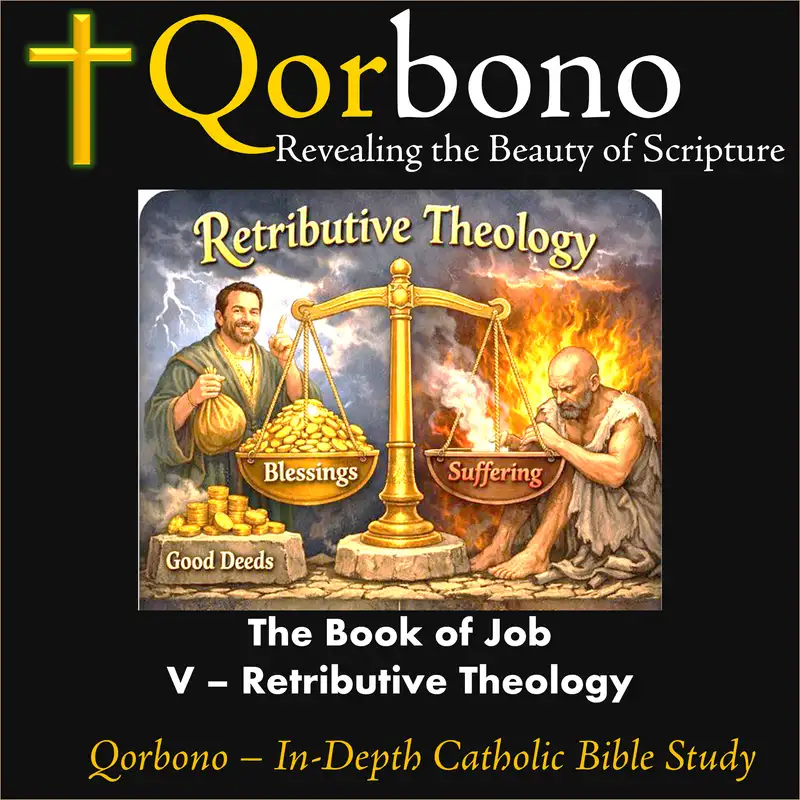
Let's talk about Calvin and the logic of retributive theology. So Calvinism, um well actually before we get into what Calvinism is, let's refresh our thoughts around what retributive theology is. So what it does, this specific brand or style of theology teaches that good is rewarded and evil is punished. Particularly it implies that
01:57
When you're a in good standing, a Christian in good standing, you'll get all your wishes. This is what typically we mean by good. And when you don't, well then, you are punished. And if you speak to priests, generally they will tell you a lot of people go to them and, I mean, some people go to them and say that they're being punished by God because of XYZ.
02:25
So this notion of punishment and reward is very much alive. And it's something that while we must be aware of because of the covenant that God does bless and curse, and it's something we have to take very seriously, we shouldn't equate His blessing and curses with our understanding of what good and evil is. There's a disconnect there that we have to be very careful about. So in Deuteronomy 28,
02:52
and in Proverbs, and I would say in Leviticus 26 as well, you'll see those curses and blessings come down and are pretty serious. Christ Himself also had blessings and curses in the Gospel, particularly in Gospel of St. Luke and the Gospel of St. Matthew. So these are real. But where we go wrong with it is when we try to interpret someone's status and derive from it
03:21
a judgment by God. And that is the heart of retributive theology. In uh some Protestant circles it's known as the health and wealth gospel. The idea being that if you are a Christian in good standing, if you take Jesus as your Lord and Savior, then you will be healthy and you will be wealthy.
03:45
And obviously this locks you down in a mode of thinking about God that is utterly false.
03:53
uh So, for instance, the book of Ecclesiastes and the Gospel of St. John, as we shall see next year, completely reject this oversimplification. And so does the book of Job. And um St. Gregory the Great, for instance, and others, read Job as a figure of Christ, demonstrating that suffering may be redemptive rather than retributive. Meaning there is another purpose for suffering, which I will...
04:22
cover again when we hit the sovereign and permissive will of God.
04:28
With that in mind, let's look at Kelvin.
04:33
So Luther was the one, Luther was an Augustinian monk who then subverted the faith and um introduced some key changes to it. One that I already mentioned to you, which is that he took faith from the faculty of reason and made it a faculty of the will. When he introduced this famous sentence, idea being that if you take Jesus as
05:03
He didn't really introduce it himself, but that got derived from his teaching that if you take Jesus as your personal Lord and Savior, you're done. That is not faith, that's magic. See, that's an act of the will. You wave a wand, Jesus is my personal Lord and Savior, I'm saved, that's it. So, it has nothing to do with what faith is. Faith is the illumination of your reason so that moved by your will, you do what is right.
05:30
Calvin took Luther to his logical conclusion. And here's a summary.
05:41
First, this is a teaching by Luther which not many know, not even many Protestants are fully aware of this. Humanity is totally corrupted by sin. It's called total depravity. Whereas the Catholic Church teaches that original sin introduced a wound we called concupiscence in us, but did not remove all that is good in us, to Luther and Calvin, original sin
06:09
made us completely and totally depraved, which means there is no possibility of change or holiness in us. Not in this life.
06:24
So when you hear terms like grace or faith spoken by Protestant, they mean completely different things. For us, grace is an inward energy meant to spur us on onto holiness. For them, grace is an outward example given to us by Christ to...
06:52
make us believe that Christ will save us. But inwardly, we are the same depraved people, no matter what we do. There is nothing that you can do, nothing that you can do that will infuse holiness in your soul. It's a religion of despair.
07:15
has nothing to do with Christianity.
07:20
Fortunately, nobody lives by that. There aren't many Protestants who live by that. But now Calvin, since we are totally depraved, the question became, well...
07:37
How are we saved? And so Calvin introduced this notion of irresistible grace. Again, remember, grace is not what we mean by grace. Grace is outwardly. And the idea that God makes this magnet, so to speak, and pulls you towards Him, and it's irresistible. You cannot resist it.
08:06
So effectively, Calvin denies human freedom.
08:13
God, and then he then therefore he took it to the final conclusion that when God creates a human being, at the moment of that creation, God predestines some to heaven and some to hell.
08:37
and there is nothing you can do about it. It's stamped on your soul the moment of your creation. And this is called double predestination, contrary to the Catholic predestination, which says that God predestines all to heaven.
08:56
yet at the same time he respects human freedom. Now how that works is a whole different story, but that is the Catholic outlook on predestination. The Calvinist outlook is this double predestination, where from the very beginning you're either predestined to hell or you're either predestined to heaven.
09:18
Those truly saved will persevere in faith until the end. Perseverance of the saints. Perseverance in faith again means only one thing. That you take Jesus as your savior. It doesn't mean you're growing in virtues. It doesn't mean you have a life of prayer. It doesn't mean you're doing anything interiorly to transform you. There's none of that. It's all outwardly. Because only Christ at the end will save you. And again.
09:48
It's magic.
09:51
In short, salvation depends entirely on God's sovereign choice, not on human freedom or merit. And so that is actually similar.
10:04
It is similar to this retributive theology because
10:12
it establishes a pretty simple and straightforward rule that determines who will be saved and who will be damned.
10:22
and it emphasizes the sovereignty and inscrutability of divine will, which is good, but
10:33
It has the same kind of consequences as retributive theology. It's not merit-based. You see, it's funny. In a sense, almost the opposite of merit-based theology, which is what retributive theology is all about. Based on your merit, you're either blessed, or based on your demerit, you're essentially punished. That's what retributive theology says. Calvinism says, no, doesn't matter. There is no merit. There is nothing you can do. It's all decided.
11:02
The consequences are the same.
11:06
So the reason I bring this up is to help you understand that this retributive theology we saw in the Book of Job isn't something that is dead, that happened back then and when Christ came, it went away. It's very much alike. This is one example of it. So, in Calvinism, suffering or loss is easily interpreted as evidence of divine rejection.
11:35
which is what the distributed theology does. It also leads to spiritual anxiety and fatalism. The believer may question whether trials signify reprobation. So any form of trial may be understood immediately as, God, I'm a reprobate. I'm one who's going to hell.
11:57
So if you know people who are Calvinist, I'm hoping that by now this word isn't just resonating as some sort of, oh, know, brand of Protestantism, it's something to really take seriously and pray for them because it is very harsh. Calvinism is a very harsh brand of Protestant faith.
12:22
In contrast, the Catholic Church affirms universal, salvific will of God as we see in 1 Timothy chapter 2 verse 4, it is also clearly spelled out in the Catholicism of the Catholic Church, paragraph 1037. And the mystery of divine providence. It teaches that grace works through freedom, not against it, and that suffering can be redemptive rather than retributive. So I hope you appreciate what you have, the treasure that you've been given.
12:54
because there are a lot of people out there who don't have what you have.
13:06
So, like I said, the Church affirms divine sovereignty and genuine human freedom. We do have, we have a hard time getting those two to work together. We don't have a good solution for that, but we affirm it. Grace is primary, but man can freely cooperate or resist it. There is no irresistible grace. Grace is given you, you can receive it or you can reject it. God is not going to force grace upon you.
13:34
It's a choice you make. Christ's redemption is universal in scope, offered to all.
13:46
And it's up to each person to accept or reject.
13:53
So that universal redemption that Christ offers to all hopefully should help us move away from groupthink, which is another way in which retributive theology raises its ugly head.
14:16
Anytime you're tempted to wholesale judgment about a group of people,
14:24
whether they're X, Y or Z, understand you're falling into a retributive theology. Now group thinking is important, you have to use it because otherwise you can't function. And I get that. But there's a difference between using group think to function and to judge.
14:45
Anytime in your head you ascribe the evil of this world to some group, and I don't care what that group is, it doesn't matter.
14:58
Anytime in your head you are tempted to accuse a group by which you anonymize everyone in it into a group, you're falling into retributive theology.
15:13
Christ did not do that.
15:16
Most of the time in the Gospels, he didn't care if somebody was a Roman, a Jew, a Galilean, a Syrophoenician, didn't matter. What mattered to him was the person.
15:31
And if you want to imitate Christ, that's what you're supposed to
15:35
So, beware of judgment that is driven by groupthink. You're falling into a tribute of theology and I'll show you what God has to say about that. It's actually very serious. It's not a light matter. All right. You have not spoken right.
15:55
In Job 42.7, God rebukes Eliphaz and the two other friends, You have not spoken of me what is right, as my servant Job has. It sounds very mild.
16:10
you have not spoken of me what is right as my servant Job has. In contrast, Job, who questioned God openly and emotionally, is vindicated for having spoken rightly. So it's not that God is asking us to shut up, put up, never ask any question, accept everything.
16:34
and not engage in. That's not what God wants.
16:42
That's not what God wants. He, you can see it in the case of St. Martha and St. Mary, when Lazarus died, they engaged with him. Lord, if you've been here, he would not have died. They had no issue engaging with him with sincerity, with full emotions, with honesty. So if you're suffering, if you're in pain, if something is not making sense, don't go to God with false piety.
17:13
go to him with sincerity, of heart, with trust, but with complete honesty. That's what he wants. So what does it mean, you have not spoken of me, what is right? The contrast echoes a striking moment in life of St. Thomas Aquinas. According to tradition, Christ appeared to Aquinas in a vision and said, you have written well of me, Thomas. What reward would you have?
17:40
St. Thomas was very humble, he was a mystic. People sometimes don't know that. He was a mystic. And he wrote what he wrote not because he was compelled to show off or demonstrate his knowledge or try to explain things rationally about the Trinity. He was doing it because he was fighting heresies. The Arian heresy was very strong at the time and there were other ones.
18:08
And his whole thrust was to teach the truth and help people not fall into heresy. That's what he was doing. And that's what God, when Christ told him, you've spoken one of me.
18:21
So, you have not spoken of me what is right. The declaration emphasizes the sacred responsibility of speaking truly about God. You have to speak truthfully about God. Guess what? When you take a whole group, and you judge them, that group of people has been created by God, and you're judging all of them
18:52
You are not speaking what is right of God.
18:58
You're not slandering these people, you're slandering God. It's a very serious sin.
19:08
And like I said, doesn't matter what group it is.
19:16
Unless you have hard facts, hard evidence in your hand, that is unimpeachable, that can be presented in court, be very careful.
19:35
So among many of you are from the Middle East and obviously one of the target group for Middle Middle Easterns are the Jews.
19:48
The Jews run the world. The Jews control everything. The Jews do this. X, Y, and Z. Jews this, Jews that. You are slandering God when you say these things.
20:06
It doesn't mean that you're not allowed to criticize Israel for their policies or their actions. You criticize them as you would any other country. That is normal. But when you say the Jews...
20:20
You're in a hot seat. I don't want to be in your shoes.
20:32
This is just one group. Pick any other group you want. Whenever you do that, you're slandering God.
20:43
Now, in contrast,
20:47
And then by the way, typically when people, I've never heard uh people speak of a group to praise them.
21:00
So there is a complete lack of mercy, a complete lack of charity, and by the measure you will measure, that measure will be used against you.
21:14
So, you must be very careful when speaking against any group.
21:23
By contrast, Job is not concerned with groups. He's only concerned with God. His whole focus is on God. And he has a pretty daring things when he basically says, I want God to come and talk to me. want him to explain to me. He's basically calling on God. And then he says, I need a mediator. He's very demanding. Not sitting back and just piously praying the rosary and waiting for something to happen.
21:50
is fully engaged with God and not once does God criticize him for that. Not once does God say of Job even though what he said was wrong that you did not speak right of me.
22:04
So Job, God is not afraid of arguing with you. He'd be happy to do that, provided you engage him the right way. So beware of speaking what is not right about God.
22:25
Like Job, St. Thomas Aquinas approached divine mystery with humility and awe, never claiming to possess it, but always seeking to proclaim it truthfully. So here's another example. The Church right now issued a directive that the title Mediatrix of All Graces should not be used as such by Catholics about Our Lady.
22:49
The Church spoke. Our job is to understand, internalize, accept and move on. Not
23:03
concoct some theory about the Vatican doing this and then the other. That doesn't matter. The church spoke. We are the children. We accept what the church says. We internalize it. We understand it and we move on. That's what we do. That's what Job tried to do with the whole. His whole piece was, am suffering. I am not guilty of any sin that would explain my suffering. I need God to tell me why.
23:36
And God said, fair, I'll tell you what.
23:46
In Job 42.7, the Lord condemns the friends not merely for bad reasoning but for theological malpractice.
23:56
See, that is the problem. You have not spoken of me what is right, which means it's heresy, which means it's wrong theology, which means you're leading people astray. A lot of bad consequences when you do that. Jesus himself warned, I tell you, on the Day of Judgment, men will render account for every careless word they utter.
24:21
There's a difference between careless words I utter about me, or about a rabbit or a cat, and careless words I utter about God, or about people He created.
24:36
So do not be quick to judgment. Do not be so certain of yourself that you can accuse a whole group of people without having hard data that you can even present in court.
24:53
Catechism teaches respect for his name is an expression of the respect owed to the mystery of God himself. So obviously, I'm assuming here, I've even mentioned it, I'm assuming you're not using the name of the Lord in vain.
25:08
Because if you are, then that's a whole different ballgame.
25:13
The second commandment forbids every improper use of God's name. So please, if you're in a habit of saying OMG, stop. Whether in short form or long form, I don't care. Just stop.
25:30
You're playing with fire.
25:35
Unless you're saying it as a prayer, that's a different story. Most of the time, that's not how it comes about.
25:43
Blasphemy is directly opposed to the Second Commandment. consists in uttering against God internally or externally words of hatred, reproach, or defiance. So that extends when you do it against the Church, against priests, against bishops, against the Pope, and then more remotely against people, general group of people. It's a very different thing than when you accuse someone of a wrongdoing.
26:10
and you can back it in court. We're not talking about that. We're talking about these sort of general statements that are made. Be very careful. Christians are called to confess their faith without giving way to fear. Preaching and categorizing should be permeated by adoration and respect for the name of our Lord Jesus Christ, which means we should always be aware that God is in control and we should listen carefully with humility to what the Church teaches. And when we meet people,
26:40
We should always be cognizant that some of those people are sent actually by God because he wants to meet us through them. preserving and protecting the dignity of every human being you meet is a way of preserving and protecting the dignity of the name.
27:06
All right, let's move on. I'm going tell you a little bit about René Girard. This book, Things Hidden Since the Foundation of the World, is revolutionary. Most Catholics don't know about it. It's not easy to read this book, but now, fortunately, the people who stepped up and have introductory material about it. There three parts of the book. One is called fundamental anthropology. The second is called interpersonal psychology. And the third is called
27:35
Judeo-Christian civilization, something like that. And in it, Girard deploys a very powerful and compelling understanding of human being based on one idea. ah But before I get into it, he was born in France, in Avignon, and then he trained as a historian, a literary scholar, and he came to the United States after World War II.
28:02
and taught at major universities including Duke, John Hopkins, and Stanford. His groundbreaking insight was a discovery of what we call mimetic desire. Mimic is another word for imitation. Idea being that human beings learn most by imitation. Watch little babies, toddlers, they learn by imitation. They observe and imitate. And imitation is a very important mechanism for us to learn anything. You want to learn how to cook, you imitate the cook.
28:32
you want to learn how to ride a bike, you imitate the ones riding the bike. Imitation is extremely important in everything we do. And it has far-reaching effects on all of us, which is that... um
28:48
The human desire, what we desire, is not spontaneous. It's imitative. We desire something because somebody else desires it. And if you observe yourself, especially today with social media, you'd see how strong that is. eh What we desire is typically, I desire object A because I know someone else who desires the same object.
29:13
In fact, they've done these experiments with children where they would take these balloons or these balls of different colors and they would put them in front of the kids and the kids initially have a very peaceful reaction to them. Then an adult walks into the room, grabs one of these balls randomly, plays with it for two minutes, puts it back down and leaves.
29:36
automatically there is a fight among the kids for that ball.
29:40
It has nothing different from any other balls, but it's the imitative factor, the fact that they want to imitate the teacher or the grown-up, or the ideal, the one they idolize that caused that. You see it in games. People go to games wearing the clothes of the players. You see it at Halloween. People imitate. They wear the things that matter to them, express their ideals.
30:03
So imitation is something that is intrinsically fundamental to how we behave and how we learn. Now, because of this, there is then a scapegoat mechanism that is put in place, which is that societies preserve order by uniting against the victim blamed for their disorder.
30:27
So it's, I mean, he takes time to deploy this idea, but fundamentally, what happens was that when there is a problem in society, a grave problem, we then imitate one another and accuse somebody. And we become united in our accusation that person. I just mentioned a little bit earlier, groups of people or persons.
30:55
I was in Canada for about a week and most Canadians spend their time talking to me about President Trump. They're Canadians talking about President Trump. So some people become lightning rods and all the ills of a society are blamed, are put upon that person. These people are scapegoats. And the scapegoat mechanism is universal across all societies. Every society have had scapegoats.
31:25
People that were accused of something, they're charged, and then they use their execution as a way to bring back peace. It's been, it's universal across all of history. And so this is his insight that this was happening. And then his second insight, which basically converted him, was that after studying myths across the whole world, he came to the Bible considering it myth.
31:54
That's the starting point. The Bible is just another myth. And then what blew his mind was that the Bible is the only book, the only book that doesn't side with
32:11
the accusers. It sides with the one with the scapegoat and proclaims the innocence of the scapegoat. It's present nowhere else in any other writing, only in the Bible.
32:28
And then some of the text is very old, as you know, 4,000 years old, 3,000 years old, 2,000 years old. So he embedded two texts of the same period, and only in the Bible does he find that repeated phenomenon where the writer sides with the victim, not the accuser. Hence, the Book of Job.
32:50
The Book of is a primary example of this phenomenon where you have a scapegoat, designated scapegoat. You have the three friends representing the community. In a scapegoating mechanism, we need the scapegoat to declare that they're guilty. They have to declare their guilt. And the whole thrust of the friends is to make Job declare he's guilty. It's that if you read other myths, you will see that mechanism repeat itself. You will recognize it. And yet, the whole purpose of the book, that what you have,
33:20
The author of the book, his perspective is that Job is not guilty, he's innocent.
33:28
that through Jihafour loop.
33:33
And so he realized that human violence hides behind sacred order, hence retributive theology. The whole purpose of retributive theology is to maintain the order. We hide behind orders which we declare sacred.
33:50
And we maintain peace through sacrifice. Channing aggression onto a scapegoat. The victim is blamed for the disorder and his death restores peace. The victim is accused so that the persecutors may believe themselves innocent. You see that in the scriptures. You see that in the Gospel. Very, very clearly. The scapegoating mechanism in the Gospel is incredible. You see that consistently. Jesus goes to his...
34:18
own village among his people and he doesn't perform a miracle and he really obsesses them. did they decide to do? They take him to the brow of the hill and they want to throw him down, right? But he passed through them. And Girard comments that he's seen the same story told in other cultures, but in the case of other cultures they would say that when they took that victim to the brow of the hill, the victim flew away. And then by flying away, they brought peace down.
34:47
In words, they transformed the murder into a myth. And his point is that behind every myth, there's a murder.
35:00
So the scapegoat mechanism, mimetic desire, we imitate each other's desires leading to rivalry.
35:08
There's a crisis. Rivalry threatens social order. So what is the rivalry? We all want the same thing. There's not enough of the same. So there is a crisis. It then causes a disorder in society. There is a threat to the social order. So in order to be able to fix this problem, what do we do? We look for somebody who's causing all this. Surely it's not us. It's not our greed. It's not our lust. It's not this. It's not that. It is someone else.
35:36
And typically these are people who have something exceptional about them. An exceptionally beautiful woman, a midget, someone who has, let's say, blue eyes in a society where no one else has blue eyes. Something, a distinguishing feature that cause everyone to say, aha, it's this person who's doing this. We need to blame on them.
36:00
And then...
36:02
We kill the victim and create a myth that masks their innocence.
36:09
and proclaim ours.
36:13
This is the founding mechanism of culture and then Girard does a masterful job as demonstrating this. Shows you this repeats over and over and over again.
36:24
And so we are all tempted to find scapegoats.
36:31
The whole idea of groupthink is founded upon scapegoating.
36:37
We want a group that we can accuse of the ills that we're going through and blame them for it with no evidence to support our claim.
36:52
This is the founding mechanism of culture and this is why Christ says, have come to reveal things hidden since the foundation of the world, title of the book taken from the Gospel of St. Matthew.
37:03
Because like Bishop Sheen says, all civilizations are founded upon tombs except the Catholic Church, which is founded upon an empty tomb.
37:18
So Bishop Sheen understood that very, well, even though he didn't have the whole mechanism behind it, but he caught that.
37:25
Look at Egypt, the pyramids. Everybody celebrates the pyramids. Where are they? Tombs. What happened in these tombs?
37:33
Pharaoh dies and they bury everybody else. They leave them there to die. And we celebrate that. We praise the pyramids. They're death machine, they're torture chamber. That's what they are. But we accept them as a sign of glory.
37:56
except the empty tomb, the tomb of Christ.
38:01
So, the Bible reveals the innocence of the victim. In the pagan myths, in all of them, the victim is always guilty. So, Romulus and Romulus, the founding of Rome. They are two brothers, are twins. And they are now tracing the contour of the city. One of them, I don't remember which one, stepped outside that boundary. Because he stepped outside that boundary, he violated some sort of a mysterious rule. His brother killed him and then founded Rome. What is interesting,
38:31
is that the author of this myth sides with the murderer. He's on the murderer's side.
38:40
In contrast, Abel and Cain, again, two brothers. One murders the other.
38:50
Both offered sacrifice. You can see the mimetic phenomenon going on here. One offers, the other imitates him. He offers as well. One offer is accepted, the other is rejected. The one whose offer is rejected kills his brother and start the Canaanite civilization. But the point of view of the author is with Abel, who's declared innocent. That's revolutionary.
39:17
No other civilization has that point of view about scapegoating. Only in the scriptures.
39:26
From Abel to Joseph, Job the suffering servant, and Christ, revelation unmasks human violence and shows God sides with the victim. That's what changed all of civilization. That's what changed the whole life on earth. This is why Christianity is the foundation of peace. Without Christianity, there is no peace. There is scapegoating.
39:53
In Job, Jair sees the clearest Old Testament rejection of scapegoating. Job's friends form a scapegoating chorus. Job insists on his innocence. God vindicates Job and rebukes his accusers. My wrath is kindled against you, for you have not spoken of me what is right, as my servant Job has. Job reviculates Christ, the innocent victim. One masks violence disguised as divine justice.
40:21
We don't appreciate that because we live it. We don't appreciate the breakup of this whole scapegoating mechanism since Christ came, because we live it. Because this notion of victimhood is now very well entrenched. We're almost in the opposite situation where instead, where before no one wanted to be the victim, because if were the victim they'd be scapegoated. And now we turn it into everybody wants to be the victim.
40:52
But that shows you the victory of Christianity.
40:57
because victims are innocent. That notion that victims are innocent isn't free. caused Christ His blood on the cross. This is why being a victim is so desirable now. It's effectively a wrong way of imitating Christ. But it is an imitation of Christ.
41:18
That is not possible. That is impossible without the cross.
41:28
Look at Muslim societies. Nobody wants to be the victim. They don't play that role, that way. Because they're not, the conscience is not imbued or infused with these Christian values. We live in post-Christian societies, but they're still infused with these values, which are very much aligned.
41:49
And in that sense, we should be still hopeful because that conscience is still Christian. The notion that victim is innocent.
42:01
So if you compare the story of Job to that of Oedipus Rex, I mentioned that to you before. Oedipus Rex is a story written by Sophocles, a great writer, a great Greek writer, and in some sense a genius. And he wrote the story of, I'm probably not saying it right in English because I'm influenced by the French. Oedipus, how do you say that? How do you say his name?
42:28
Oedipus, thank you, Oedipus who ah came to the city of, where was he?
42:40
uh Thebes, the city of Thebes, took over. It was a military coup. He took over. He basically killed the king. And then, as was the case, when you want to assert your power, you take the queen. Not knowing that the queen was actually his mom.
43:00
Later on, that was uncovered and as a result there was a plague that hits the city.
43:09
So there is the initial mimetic effect where one man wants to imitate the other by taking his job. We either worship the ideal or we kill the ideal to take his place. And he takes his place. But he breaks a law. Notice now retributive theology come into play. He breaks a law. He didn't know, but it doesn't matter.
43:37
In a religious theology, it doesn't matter whether you knew or didn't. You broke the law, which is when he took his mom as his wife, and as a result, plague, consequence, hit the city.
43:55
All right. So the scapegoat is identified as Oedipus. He is now the scapegoat. Everybody points at him. You did this. This is what happened. And what does Oedipus do then?
44:09
He is exiled and he flucks his eyes out. And once that happens, peace is restored, plague is gone.
44:20
That is the scapegoating mechanism in full play.
44:25
And he compared that to Book of Job. And this is what Jihad did. He compared the two and he said, alright, Job loses wealth, children and health and like I told you, he was at considerable wealth, therefore he affected the entire society where he was living. A lot of people depended on that. It was a significant crisis for the whole society, just as was the case with the plague devastating Thebes.
44:52
So, in the case of Oedipus, Sophocles asked this question, who has angered the gods? That's what we need to find out, who angered the gods, and we need to pacify the gods by punishing the person who did that. In the case of Job, the question is, why does the righteous suffer? That question, why does the righteous suffer, is unthinkable outside of Christianity and the Judeo-Christian tradition. Unthinkable.
45:18
This is the gift.
45:22
Christ gave us.
45:25
to question why someone suffered.
45:32
The response, the oracle declares Oedipus guilty, the friends declare Job guilty. You can see the mechanism runs exactly parallel. It's the same mechanism at play. It's the scapegoating mechanism at play. Scapegoat identified Oedipus himself. Job is treated as a scapegoat by the friends. Both of them are identified as scapegoats. Where does it differ? In the end. In one case, Sophocles, who was really smart guy, yielded
46:01
to the scapegoating mechanism, agreed with it, and accused Oedipus of causing the plague, thinking that by punishing him and exiling him, everything, know, peace is restored. He confirmed that scapegoating mechanism. The anonymous author of the Book of Job did it. They are written, by the way, these books are in temporary of each other. So how is it that you have somebody as smart as Sepp Hocklans in a very cultured environment
46:30
with a profound philosophical background who completely missed it. And you have someone from some unknown Gentile origin figure it out. That's when Jirard went, the Bible is inspired. There is no other explanation.
46:50
And so God vindicates Job. Peace is restored through what? Not through expulsion, through revelation.
47:02
through revelation.
47:07
Girard's key insight is that Oedipus Rex conceals the innocence of the victim, Job reveals the innocence of the victim. And that revelation changed the whole world.
47:20
It completely rewired our conscience and the way we think about others. It introduced the notion of mercy, compassion, care, and prepared the way for Christ. So you can see how this retributive theology is really dangerous. It pulls you away from the heart of Christ. You have to be very careful with it.
47:46
So, Christ the final revelation and the passion, the scapegoat mechanism is fully exposed. The crowd unites in violence. Crucify Him. Crucify Him. Right?
47:59
The victim is innocent. Who declares this? The Roman centurion declares the innocence of Christ. God vindicates him through resurrection. The Lamb slain from the foundation of the world, Revelation 13.8, abolishes sacrificial violence. It no longer works after Christ. And then Jirah explains that in order to compensate for that, we started having these persecutions.
48:28
where we went from a single scapegoat to whole scale scapegoating, trying to make it work again. Never did.
48:39
There were no persecutions before Christ.
48:43
they were conquering, were punishments in case of city, let's say violated the laws of the king, but there were no...
48:54
persecution the way we've seen after.
49:00
because it's wholesale scapegoating. wanted that mechanism to work again. It couldn't work with one individual. We made a whole people, a whole group.
49:11
We accuse the whole group and we go after them. And it still doesn't work. Because the innocence of Christ cannot be taken away.
49:26
Sinners were the authors and ministers of all the sufferings that the Divine Redeemer endured. Girard's theory has uncovered the permanent structures of human sin, the scapegoat mechanism broken open by the cross. And in Godium and Spe, the mystery of man is made clear only in the mystery of the Word made flesh. It's only Christ on the cross that illuminates the mystery of man. And...
49:55
Only Christ on the cross frees us from this need to accuse someone else for our own ill.
50:06
Girard helps us see that Job is not about explaining suffering, but revealing God's innocence and humanity's violence. Job revigors the cross where human accusation ends and divine revelation begins. Suffering that is undeserved, endured in faith becomes participation in the truth of God's love. And it's a hard lesson for all of us to accept. It's all on suffering. We want to run away from it.
50:36
All right, let's now, I have only few minutes, but I'll try to cover as much as I can, because everything leads to this, this notion of God's sovereign will and permissive will. I've touched upon that a number of times, but I'm going to try to cover it little bit more attention. So.
50:57
Sovereign versus permissive will. Sovereign will, what God directly intends and brings about for His glory and our salvation. Permissive, what God allows to happen, though He does not directly will it. Key insight. God permits suffering not as evil, but as a path to deeper love and understanding. So that's what you need to shift away from. When you see the world seemingly going haywire, when you see all this insanity around you,
51:27
You need to shift away and understand that God permits it so that truth may be revealed.
51:36
When you start to do that, when you shift away from looking at the world around you and becoming anxious, which is what the devil wants, to looking at the world around you and then stepping back in awe, thinking, what is God doing? What marvel is he about to bring?
52:01
your entire inner disposition changes. Because you understand suffering differently, the way you're supposed to understand it.
52:13
Nothing happens unless the Almighty wills it, either by permitting or causing it. Nothing happens. Nothing happens unless the Almighty wills it, either by permitting it or causing it. And in both cases, it is to bring about the greater good. If you start to think this way, if you align yourself with this thought, which is not easy to do, which is hard, but that is all the work of your virtues. When you work on your virtues of what you're doing, then
52:40
then and only then you're starting to live the Christian life.
52:45
Everything else is preparation. So do not confuse piety with holiness. Piety is when you say your rosary, when you go to Mass. You can go to Mass every day, can say the rosary every day, you can go to confession once a week, you can do all these things. All you're doing is filling your tank. You're just filling the tank. You haven't gone anywhere. So you fill the tank, you sit in the car, you go nowhere.
53:11
It's all wasted. You have to go somewhere. What is going somewhere? You've to do something with all this energy. Grow in virtue. That's what you're supposed to do. Grow in virtue.
53:25
And the first virtue you need to develop, the first one, and the most important one, is the virtue of hope. Hope that everything that God is doing is for your greater good, and for the greater good of the world, and for His glory. That hope, that's an act of the will. That's one of the most important acts of will. It precedes charity. You can't have charity without hope.
53:51
It's not possible to have charity without hope. So you have to work on developing hope by constantly reminding yourself what God is doing is great.
54:02
and trusting that everything that is happening will have a happy ending.
54:09
It takes a lot of work to do that. Because of concupiscence, understand this, not because of you personally, but because of concupiscence. Your concupiscence drags you down. The wound drags you down. Original sin drags us down. It's built in us. So it's hard. We may not succeed, but we should always try.
54:35
In Catholic theology, God's sovereign will is one and simple. It is not divided into parts or compartments. There is no, oh, here's the sovereign will of God, and here's the permissive will of God, and these are two separate things. There is no such thing. God's is simple. We use these concepts to help us better understand in human terms what God's doing. When we speak of permissive will, we're not referring to a separate willing God, but rather to a mode of His willing.
55:02
A way that his eternal decree interacts with created freedom and secondary causes. It's the same will. One will. There isn't two. There's only one. But a different way in which this will interacts with us. In God there is only one simple act of will. What he wills, absolutely he causes. What he wills permissively, he allows. St. Thomas Aquinas. So God's sovereignty wills to permit certain evil.
55:32
It's not like God's sovereign will is here and God's permissive will is here and then two don't know. God's sovereign will wills his permissive will. They're completely connected. They serve different purposes, but it's for the greater good. God's will is one and simple. What he wills absolutely he causes. Like I said earlier, I'm not going to read it again. So permitting is not causing. Here lies the crucial nuance and the reason we cannot collapse the two into one.
56:01
While God's sovereign will embraces His permission, the mode of willing is different. God directly wills and affects the good. That's in sovereign will. So, the good is creating you, sustaining you, giving you graces. Those are all due to His sovereign will. You have nothing to do with them. It's all His will. Permissive will, God will not to prevent an evil.
56:25
He knows it's an evil, he wills not to prevent it.
56:29
The good itself, creation, grace, redemption, all these things are subject or object of his sovereign will. The allowance of evil, not the evil act itself, is the subject or the object of his permissive will.
56:44
He allows it, he doesn't cause it. It's an efficient cause, meaning it's directly caused by God. It's deficient cause. God allows secondary causes to act freely. And the sovereign will is a manifestation of divine goodness. The permissive will is the greater good he foresees. It's in his permissive will, in a sense that we see God's greatness. Because it would be, it's a weaker God who has to force everyone to do what he wants in order to achieve the greater goal.
57:12
It's a stronger God who allows everyone to do whatever they want and still his will is achieved. And that's what you have to be convinced of. This is all of Job. This is the purpose of the book of Job.
57:25
God is in no way the cause of moral evil, He permits it, respecting freedom and drawing good from it. This distinction matters because if we erase it, then God causes what He permits. We're back to Calvin, you see. In Calvin there is no permissive will, there's only a sovereign will. Because when you're created, God decides whether you're going be going to hell or going to heaven. Everything is decided, there is no freedom. So you can't collapse the two, you have to keep them separate.
57:56
And we would fall into the theology of Job's friends, the idea that divine power must be the immediate cause of suffering or guilt in every case.
58:11
In some cases it's absolutely true. When God sends someone to hell, that's the immediate cause. That's the condemnation. But it's not always the case.
58:20
Jihad would add, such a theology turns God into a mythic deity, the author of violence, rather than the one who reveals and redeems. In Job's Revelation, and ultimately the Cross, shows us a God who is so sovereign that he can even allow evil without authoring it, and yet so loving that he transforms it into redemption. That's the power of the Cross.
58:45
The love of God knows no bound and it can transform every evil into redemption. You have to be convinced of that.
58:54
So, God's sovereign will includes his permissive will, but does not collapse into it. God sovereignly wills to permit evil for the sake of greater good, but he does not cause evil as he causes good. His permission is sovereign in its purpose, yet distinct in its causality. And here's a simple visualization. God's sovereign will allows created freedom, which permits evil, and the purpose, the reason why he permits evil is to redeem evil for a greater good.
59:25
Always. To redeem evil for greater good. So whenever you're tempted to, whenever you have this wave comes at you, wave of anxiety, a wave of defeat, a wave of notion that, oh, what's happening out there is overtaking everything, everything is to get this, all of that is not from God. All that disquietude, all this anxiety is not from God. And you have to develop the fortitude and the hope to reject all that. Wholesale, not entertain it.
59:55
and refocus on the cross and the power of Christ.
01:00:00
O Felix culpa, O happy fault that earned for us a greater Redeemer. What is the happy fault? Adam and Eve's fault. It's called the happy fault. Because without Adam and Eve committing original sin, Christ would not have come to redeem us. This is Exhibit A of how God permitted an evil from which He derived a much greater good. Without that evil, our destiny would be to live happy here on earth. We would have lived
01:00:29
in a state of natural beatitude. We would never have seen the beatific vision. We would never be in God's presence. You understand that? We would have had the initial goal, the initial plan, is living on earth. Happy! But because of that fault, we're now capable of becoming true sons of...
01:00:53
Here's the pattern. This is what God does all the time. Big things, small things, doesn't matter. All the time.
01:01:04
Wait a minute, I skipped the whole section, which was important. So I'm going to summarize it for you before I get into it. The reason I've told you all of this is because there is a really important aspect to the pastoral side of um this sovereign will versus permissive will. Here's what people do, typically. They ascribe what is good to God's sovereign will, and they ascribe what is bad to God's permissive will.
01:01:35
And each one of them defines, each one of us define good and bad according to our own...
01:01:45
When we do that, when we determine that God's sovereign will is only about good things and God's permissive will is only about bad things, we fall into a trap. The trap is that we, number one, weaken God.
01:02:04
Because there is nothing you can do about bad things. It just allows them and they happen and that's how it is. Two, we weaken the fear that we have of the Lord which is the healthy fear that is the foundation of wisdom.
01:02:20
The fear of the Lord is the beginning of wisdom. You're not going to fear somebody who basically only acts like Santa and gives you good things. You're going to fear whatever is causing you the bad things, which is not God. Guess what you did? You're back into retributive theology. You're back into that exact same trap. If it's good, it's from God. If it's not good, it's not from God. You've determined everything. And now your life is full of anxiety because it's out of control.
01:02:50
God obviously is not in control. He's in control of the good things, but He's not in control of the bad things. He just allows them and what can we do?
01:03:00
So anxiety sets in, despair sets in, creeps in.
01:03:06
And then we categorize everything according to whether it's good or bad from our perspective. And we reduce God.
01:03:16
our own appreciation of things. And now we speak, we do not speak right of God. We basically fallen into a heresy.
01:03:30
Why? What is missing from this whole picture? What missing is what I said earlier. God's permissive will isn't about bad things. It's about greater things.
01:03:44
God sovereign will is about things that are great out of the box. We see them. But God permissive will is in a sense more glorious because ye allows, gives the latitude to His creature to do whatever they want and yet He makes something awesome out of it. It's that bit that we forget practically speaking.
01:04:13
that everything that is happening in the end always turns to a good. No matter what it is, no matter how it feels, no matter how we live it, it always turns to a good. Which is why we shouldn't break divorce permissive from sovereign. We shouldn't line them up with good and bad. Rather consider them as two modes in which God acts for the same goal, which is to bring about His glory and
01:04:43
Our good.
01:04:46
Once you start to see it this way, you start to sort of take a step back and you're now like Job. I don't understand why this is happening. I'm suffering. I don't know why. I know I don't deserve this suffering, but I am in pain. I can join my pain with Christ and I can wait. And I'll wait on God and I'll engage God.
01:05:07
But I will not categorize God according to my understanding of what is good and what is evil. I'll refrain from doing so because I am not God. And I will always hold to the fact that God is good and everything that happens happens for his greater glory. So I can keep my peace and stay focused where I need to be, which is my salvation and the salvation of the people around me and of his church. Thank you.