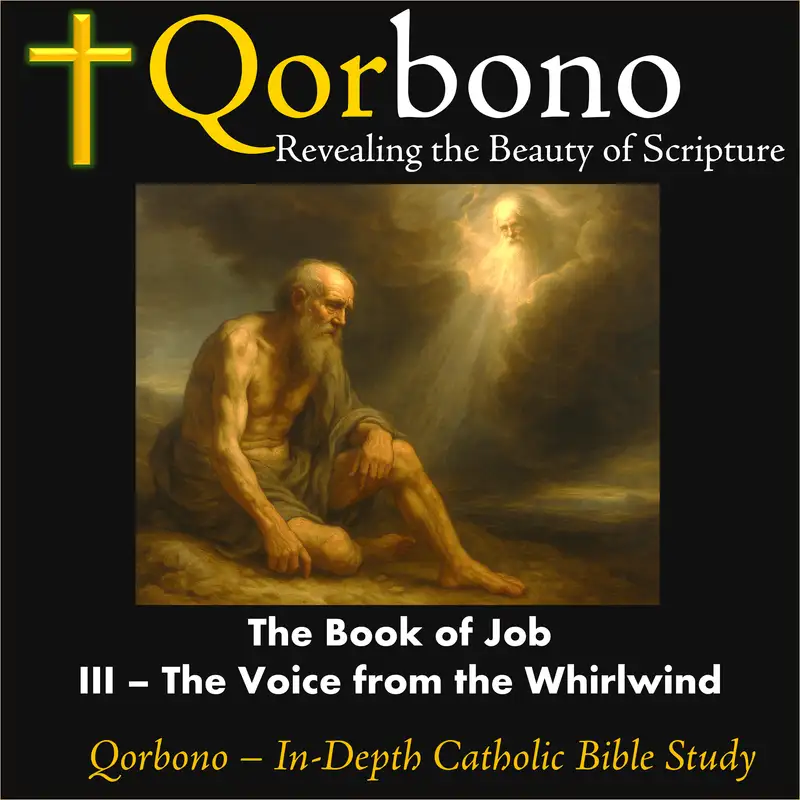
03 - The Voice from the Whirlwind
00:01
We're going to again remind ourselves where we are. We basically have completed the first two lectures where, and then drama begins, we'll look at the test that Job was put under. And then last time we looked at the trials of friendship when his friends came over and then presumably tried to help him. But in the end, we're not very much hopeful.
00:27
And then tonight we're going to look at chapters 32 through 42, where we see two things happen. Number one, a young man named Elihu will step up and will challenge Job in ways that are more productive, I would say, than what his friends did. And then God will speak to him from the whirlwind. And in two weeks from now, we'll close when talking about restoration.
00:56
ah As usual, you you have a number of QR code you can grab if you so wish. The first one is for questions. If you grab that QR code over the phone, you'll be able to text questions and you can do it anonymously or you can ask questions in the end. This is just to help you in case you have questions as we go along and you wanted to remember them. It'd be a way to do that. The few other ones you don't have to pick up right now. I always include these um
01:26
the slides in the talks afterwards. But the top one is for the podcast. It's the audio podcast of the second lecture. And the two bottom ones are the video, which was streamed last time. And you can either watch them on YouTube or Vimeo. So I'll give you a minute to grab those before uh we move forward.
01:52
And for those of you who are on the stream, if you don't want to use the QR code, you can just go to slido.com and then key in the code Jaube03 and it get you straight into the page where you can ask your team also, um, text your questions and I'll see all of them on my phone when I look at questions that have been submitted, if any.
02:19
Alright, I have another slide for you with more QR codes. Yay. Last time I did talk to you about this Saint. Her name is Saint Rafa, Saint Rebecca. And I'm giving you a few QR codes in case you're interested to know more about her. The left one is for the Wikipedia page, which you can actually, you know, grab and read about her life. The mid one is for those of you who are kind of impatient. It's about a two minute short on YouTube.
02:49
that tells you very briefly about her life. And the right one is a three hour long movie that basically goes through her life. As far as I'm concerned, it's a very well made movie and it's worth watching. It's in Lebanese, but it's subtitled in English. And the pace is slow, so it shouldn't be very difficult to follow. I do recommend watching it because it...
03:17
ties in really beautifully into the story of Jo and suffering. Like I told you, Saint Rafa suffered from dislocation of her bones for decades. And not once, not once did the sisters who were taking care of her hear her complain or be anything but cheerful. Juni could do something.
03:44
All right, very good. So again, you can you can grab those also from the deck later once it's posted and made available. All right, with that, please stand up and let's start with a prayer. The name of the father of the son of the Holy Spirit, I meant. Come, Holy Spirit, fill the hearts of your faithful and kindle in them the fire, your love sent forth your spirit and they shall be created.
04:13
and you shall renew the face of the earth. O God, who by the light of the Holy Spirit did instruct the hearts of the faithful, rent that by the same Holy Spirit we may be truly wise and ever enjoy his consolations. Through Christ our Lord. In the of the Father, the Son, and the Holy Spirit. Amen. Please be seated. By the way, before I proceed any further, I do want to point out
04:42
One really interesting line in this prayer towards the end where we say, Grant that by the same Holy Spirit, watch the order, we may be truly wise. So we're praying for wisdom.
05:00
so that we can enjoy his consolation.
05:05
You notice the order wisdom first, consolation next. So therefore those constellations are intellectual, not strictly emotional. And key on this, this is really important in the talk we're going to go through today. All right. So what we'll cover. There is a long silence break. And then we have Elihu who speaks, is a young voice among the, and he's a young voice. speaks from the ashes.
05:33
And then following Elihu, we have God who then enters the conversation. And there is his first speech, Job's first response, God's second speech, Job's final words, and then we conclude with the fear of the Lord is wisdom.
05:52
Before we get into this, let's again regroup and then think about what we've seen so far. Job was an upright man. He had integrity. God said so. The devil wished to tempt him and God allowed it.
06:11
What I've told you before, I reiterate again.
06:16
I do not think that separating between God's perfect will and God-permissible will is very helpful from the psychological standpoint, from the way you feel about things. When something happens to you, when you fall in a pit of suffering,
06:36
Whether it's God's permissible will, if you're anything like me, whether it's God-permissible will or God-perfect will, nah, very consoling.
06:47
I'd rather you face it head on and recognize it is God's work, as was the case with Job. God allowed Satan to tempt him. God did not tempt Job. God did not cause evil to happen to Job, but he allowed someone else to do it. So in the end, in the very end, God has to take responsibility for it. We can't just wash his hands out of it. And so now we're confronted with this mystery.
07:19
of faith. Why do we?
07:24
It's easy to think about suffering as a consequence.
07:30
I'm sorry. It's easy to think about suffering as a consequence of punishment. That's the retribution theology. That's how his friends saw it. You're suffering. It's because you've sinned. You're not suffering. You're happy. It's because you're blessed. And obviously, one of the key contributions of the Book of Job to our theological understanding is that that doesn't work. It just doesn't work. We cannot
07:59
Equate suffering or bliss with punishment or blessing. Doesn't work that way.
08:09
So that's what we saw last time. The three friends who were there and who wanted Job to admit he had committed a sin and therefore that's why he was being punished. And by the way, I don't have time to get into this, but there is something absolutely fundamental here that I'm just gonna put in passing. I don't want you to think of the three friends as being shallow.
08:35
Because if you do that, then you misunderstand or you do not appreciate what is it that they're facing. It is not shallowness that drive them to a theology retribution. It is ordered peace. It is societal peace. In order to maintain societal peace, you want solutions that are simple enough for people to accept.
09:04
Particularly when there is something that threatens the entire society. Job's wealth, like I told you, would be calculated by today's standards between, you know, anywhere between 30 to 300 million. In a small town, that's huge. So when he fell, everybody else suffered. So the societal consequences are very significant, and now peace is threatened. The best way to deal with the situation is to find a scapegoat.
09:35
But in order to find the scapegoat, the scapegoat must admit that he is responsible for that catastrophe. And the hard push of these three friends were to turn Job into a scapegoat.
09:53
Once you understand that, it's a question, it's almost legal, but it's also a question of security, of peace, of structure. There's a lot that goes under this. like I said, I don't have time to go into it, but I just want you to be aware that their push is not shallow. We may actually, if we were living with the time in that town, we may be on their side, not on Job's side.
10:20
We may be accusing him just as they are. But there is something for us to appreciate that I don't have time to go into, but I just want you to be aware of. All right. The long silence breaks.
10:36
Job finishes his final defense swearing his integrity. He sticks to his point. The pain that I am suffering cannot be justified by any of my prior actions. There is no connection. But in that process, he also realized, wait a minute, I'm not the only one. Now his conscious has now widened from his own personal problem to much greater problem. Why does God allow the innocent to suffer?
11:06
The prologue is extremely critical in this case, because without it, we could be led to believe that, well, it isn't really God's doing. It is other people's doing. God has nothing to do with it. God is passively watching because of free will and the conversation. But because of that prologue where the devil shows up and God tells them, you can do those things.
11:36
There is no easy way out.
11:40
And so watch how hard this is for us. Watch how difficult this is for us because it impinges upon our understanding of who God is. When uh Jesus met the Samaritan woman at the well, he told her at one point, she was asking him, should we worship here in Samaria, Mount Gerizim or in Jerusalem? And the Lord answered.
12:10
You worship what you do not know. We worship what we know. There are two ways to fall into paganism. One is to worship the false gods.
12:24
Two is to worship the true God falsely. The wrong way.
12:33
That is what we need to be very cognizant of. Very easy for us to worship the true God the wrong way. So how? Well, um the Catholic Church has certain teachings that she wants us to abide by. If we do not abide by those teachings,
12:58
We fall into
13:04
So.
13:06
Obeying the teachings of the church is not optional if you want to worship God as he wants to be worshipped.
13:19
That's hard. The other thing that's really hard is this whole idea of suffering injustice. We have certain standards we think God should abide by.
13:32
We have a certain life and if God loves us, he will protect this life. We have even implicitly, conditional love.
13:45
God doesn't do what we want him to do, then God doesn't love us. If God takes away our son or our daughter or our wealth or our fortune or other things that we deem essential, critical, important, would value in, then God is not God. where Job had to face that challenge at all, he lost his children, he lost his fortune, he lost his health, and he's being accused of being a sinner.
14:15
reputationally, is also being imputed by doing something he never did. So he is now facing this head on and he's also realizing I'm not the only one. So many others are also in the same boat. Why would God allow that?
14:34
And he demands an answer. He realizes God in a sense right now is my enemy. We're at odds. I need a mediator between me and God. The notion of a mediator follows logically. I need somebody to mediate between God and me. I need someone to come in and explain this whole thing. Talk to God and talk to me and help me understand what is going on. And so
15:03
The other really important contribution in the book of Job is the necessity of the mediator, the God-man Jesus Christ.
15:14
You notice that the necessity of the mediator is born out of pain.
15:26
Now, his friends have fallen silent. They've said their piece. He's not moving. He's not changing. And they really have no logical argument to support their case because their theology retribution is falling short of the facts.
15:44
Can you, can you, in good conscience
15:49
Go and um sit next to parents who are holding the body of their baby, that's an year old, dead. Can you sit next to them and tell them, oh, well, that happened to you because you've sinned. That's the price you pay because you've sinned. You can do that, please use your hand.
16:19
This is what those three friends were doing.
16:26
and it was driven by the necessity to ascribe responsibility to someone so that social peace could be maintained.
16:41
Nevertheless, their theology just doesn't jive with the facts. It just doesn't fit. So they're silent. Now, this young man Elihu, who silent until now, enters the scene with anger and insight. His speeches prepare the way for the Lord's voice. The tone in the theology focus and the theological focus shift dramatically.
17:09
Alright, who is Elihu? His name means, he is my God.
17:18
If you understand a little bit of Arabic, El-Huwa. Basically, he is my god. That's basically what this meaning. Son of Barak El, the Buuzite of the family of Ram. Notice all these people are Gentiles. None of them are Jews. Those are not Israelites. They're completely Gentiles. Not one of the three official friends, original friends. He speaks with a fresh voice. He's young. He burns with zeal and righteous indignation. He speaks authoritatively.
17:47
Some Church Fathers saw him as a prophet-like forerunner to God's own voice, almost like an image of John the Baptizer, or John the Baptist.
18:00
Now, the silence of the friends is the end of human wisdom. This is how far you can take it on a human level. Any who appears just before God speaks, he is a transitional figure between them and God. And he reframes the debate by insisting on these two facts. God is always just.
18:26
even when he's inscrutable. What does that mean? Inscrutable is a complicated word means opaque, you cannot see through. Inscrutable then means difficult or impossible to understand.
18:44
That is key. You see, when we ask for justice, part of the package is the question, why?
18:57
Justice is connected to this why? Why did this happen?
19:05
Meaning what? Meaning we don't ascribe justice we don't understand.
19:14
whether we like it or not, we do not give credence to justice. We do not understand.
19:24
And in one sense, this is very good. Things need to be explained, things need to be proven, and things need to be determined so that we know justice is being applied appropriately. That's how it should be on the human level.
19:44
problem is we loop God in the midst of it. And when we do that...
19:50
we implicitly or explicitly bring God down to our level.
20:01
This is the temptation that the devil whispered in Eve's ear in Genesis. No, you shall not die. You will be like God.
20:18
Because if I bring God to my level, I'm raising myself to God's level.
20:24
I'm making myself go. So when it comes to human justice, it is natural and required to ask the question why. But when it comes to divine justice, oftentimes that why stems from pride.
20:45
a refusal to obey, a refusal to accept that God is God and I'm just a creature and that God owes me nothing.
21:02
That is hard. So what is then Elihu's point when talking to Job?
21:13
He's telling Job, you talk about justice.
21:19
But what you really mean is justification for yourself. You want God to justify himself before you. He's calling on Job's pride, which up until now was hidden behind this righteousness. God said Job is a man of integrity.
21:46
Many of us can't really reach to the levels that Job reaches. I don't know how many of us can actually behave the way he did with all this evil being poured upon him. Nevertheless, what is driving him now, this notion that I need answers, I need to know from God why. What is driving him is that pride, that hidden pride.
22:15
that says, want God to act according to my own term. So any whose answer is, God is always just even if you don't understand. Especially when you don't understand.
22:33
Nah.
22:42
His speech is correct, both Job and his friends pointing forward, pointing to God. And then he reminds them that silence is not absent.
22:57
God's silence is not a sign of His...
23:03
It prepares the soul to hear what God wants us to hear.
23:10
Now watch how we're now entering this realm where God is implicitly in control of us. It's no longer an implicit thing. uh One of the stains of original sin is rebelliousness. We are rebellious when we are conceived.
23:37
and we are rebellious as we grow. Rebelliousness means that I want things done according to my own terms, not according to God's terms. That's in a nutshell. And that's the battle for most of us. Most of our lives, we're fighting with this.
23:58
Meekness is such a difficult virtue to attain, but it is one of the most important virtue we should develop. Being meek means I'll follow where God leads no matter what. And I'll do it peaceably. I was going to say joyfully, but I'll reduce it. Peaceably. What are we making of us?
24:26
think this is hard.
24:34
and he who speaks.
24:37
He expresses his anger, he addresses Job directly, and he tells Job something remarkable, something extraordinary.
24:49
God speaks through suffering.
25:00
Our pain is the language of God.
25:06
How many of you are on board with the program? Well, God bless you.
25:13
Many of us are just now. I mean, yes, we're here kind of a little bit on board, but down here.
25:24
Not really.
25:28
And I'm not talking about big pain, I'm not talking Job level pain, I'm talking about highway pain.
25:34
Just highway pain. I don't need to go further than that.
25:42
God speaks through pain.
25:47
Hmm.
25:52
Now you could ask, why does God speak so faint? Well, oh.
25:58
Because in a nutshell, what I said earlier, we are rebellious. We don't want to recognize it. We don't wake up every morning thinking, oh, God, I'm so sorry, I'm rebellious. Very few of us even would apply being rebellious to ourselves. We think of ourselves as upstanding citizens. We respect the law. We pay our taxes. We do what we're supposed to do. Rebelliousness is not part of the way.
26:25
But that is a human understanding. We're not loving the way God loves. We're not loving the way God loves. God created Adam and Eve, He gave them everything. He was a father to them. What did they do? They fell around and betrayed him. Knowing that they betrayed him, they lied to him. They accused him of being the one causing all the problems. They gaslighted him.
26:50
And if you think about it, this is two creatures and we're talking about God. So the impact is infinite.
26:57
How does God react to all of
27:02
So I said.
27:06
Pain is the language of God. Here's the bit where you start to see how we are, we have a journey ahead of us. How many of us worry?
27:21
How many of us worry even for a few seconds about the pain we are causing God?
27:29
God bless you.
27:38
the pain we are causing them. In other words, how many of us or how many of you are worried about God?
27:48
That's really fundamentally what saints do. They're really worried about God.
27:55
When God told Moses, I'm going to come down and you know what? I'm just gonna clean the slate and I'll start with you. You won't be father Abraham, you'll be father Moses. What did Moses say? Far from it to do such a thing because what will the nation say about you? He was worried about God, he didn't even think about himself.
28:13
So the language of God is pain because in meditating and in thinking and in understanding the pain of God, we enter into His love. The only way we can really enter into God's love is to see things from His perspective and to see the joys and the pain. Our Lady herself said when she appeared in Fatima, remember what she told the children?
28:44
Do not offend the Lord anymore, for He is much too kind.
28:54
pain.
28:57
So now you see the distance. We started with, this happened to me. I am not responsible for all of this. Why did the Lord allow that to happen to me? I don't deserve all of this. I need an answer. And now we're starting to transition into, okay, what is the purpose of all of this pain? And how does God seize this pain? And what is the meaning of that pain?
29:27
You know what pain does, right?
29:30
breaks your heart.
29:35
eh It breaks your heart. Think about that.
29:39
God wrote the law on tablets of stone. Why? Because the hearts of the people of God was harder than the stone. That's why he did it. And he knows so because he told Ezekiel later, I will take their hearts of stone and give them hearts of flesh and I'll write my law on it.
30:05
Vary your heart.
30:10
The first step, take away your heart of stone and give you a heart of flesh. That's language of pain.
30:23
Watch Elihu's, this is just a sample I'm taking, I'm gonna go through and analyze this, but, Lord looks down from heaven, he sees all the sons of men. From where he sits enthroned, he looks forth on all the inhabitants of the earth. He who fashions the hearts of them all and observes all their deeds. The king is not saved by his great army, the warrior is not delivered by his great strength. The war horse is a vein hole for victory.
30:52
and by its great might it cannot save. 16 and 17 are just highlighting the omnipotence of God. It's not by these things that you're going to save anything.
31:04
It is gone.
31:07
Behold, the eye of the Lord is on those who fear Him, on those who hope in His steadfast love that He may deliver their soul from death and keep them alive and famine. Our soul waits for the Lord. Notice how the discourse has become interior. It has become almost contemplative.
31:29
It is not talking about this relationship that we ought to have with the Lord. It is no longer a discussion about why did I suffer this way? But it is more about what am I supposed to do with all of this? And you notice, the eye of the Lord is on those who fear Him, on those who hope, fear and hope in His steadfast love. That He may deliver their soul from death and keep them alive in famine. Our soul waits for the Lord.
31:59
very contemplative, this young man, remarkable. So God is greater than man and owes no explanation. God doesn't owe us an explanation. This is hard.
32:20
God is not required to explain anything to us.
32:28
And yet we require one. How do we know that? Because we grumble. Why is this happening? Why is that happening? What is this? What are we asking for when we grumble? We want somebody to come and tell us why. And we assume, we're so entitled that we assume God owes us an explanation. He should come and explain it right now. Like right this minute.
32:56
You guys are.
32:59
Suffering may instruct not merely punish. Well, any parents who have little kids know that, right? You use suffering to instruct your kids, not necessarily just to punish them. But as grownups, we think, you don't need that. God can speak through dreams, conscience and storms. It is who defends divine justice while maintaining God's freedom.
33:27
God is just, but God is free. He doesn't owe us an explanation. He doesn't owe us to give us anything or to make things go our way. So he shifts the focus from blame to wonder and submission. That word, submission, to submit. Submit to God's will.
33:53
Behold, in this you are not right, I will answer you. God is greater than man. Why do you contend against him?
34:02
If you agree that God is greater than you, why are you contending with God? Saying, he will answer none of my words, for God speaks in one way and in two, though man does not perceive it. In a dream and a vision of the night, when deep sleep fall upon men, while they slumber on their beds, then he opens the ears of men and terrifies them with warning, that he may turn man aside from his deed and cut off pride from man.
34:33
There you go. Cut off pride from him. He keeps back his soul from the pit, his life from perishing by the sword. We're often focused on justice. We're often focused on the things that God owe us and we are blindsided to all our vices. Now God.
34:55
He sees what needs to be done for the betterment of our soul. We don't. And oftentimes we neglect what we must not neglect and accuse God of not loving us because he's not giving us what we want. Suffering may instruct not punish. I'm not going read this. I'm going leave it here for now. And
35:23
It just shows again, any whose role and spiritual reflection is focus is on God, the omnipotence of God, the freedom of God, and the necessity of keeping our eyes focused on Him and believing in Him through our suffering. Now this requires wisdom. It requires a development of faith. I've told you this a number of times. Faith is a faculty mostly of reason.
35:52
not the will. Faith is illumination of your understanding. So you begin to see how God operates. So you can respond accordingly. Abraham had that sort of faith because when he took Isaac down to sacrifice him, he held on to the promise that God made him, which is, your seat shall all nations be blessed. And so you have to put these two contradictory statements together.
36:21
He wants me to sacrifice my son and yet by my son, he's going to bless all the nations. And that led him by necessity, logically, to conclude, well, God is going to raise him from the dead. After I sacrifice him, he's going to raise him from the dead. There is no other way around. That's the only way he could reconcile these two truths. And in that journey, St. Paul tells us that that was accounted for him. Because he had faith. What does faith mean?
36:49
precisely this, understanding that God is going to see it through. Faith is not your will and faith is not your emotion or how you feel about stuff. Faith is your conviction right here.
37:08
So, any who does not repeat the errors of Job's friends, he is not rebuked by God in chapter 42. And the Church Fathers saw him as a prophetic figure, like John the Baptist. His voice is transitional. He prepares for the voice of the Lord. Sometimes truth comes through surprising and humble vessels. Which is why, really important, to be always open to anyone who's talking to you. Anyone. You never know when God is going to come and speak to you. And through whom.
37:38
Having that openness is a form of meekness, of humility, of acceptance. Putting yourself in a situation where you don't know how God is going to come to you. Don't package God into a little Amazon box.
37:53
doesn't come this way usual. So you don't know who's going to talk to you and then it illuminates your understanding and give you a gift of knowledge that you need to carry forward.
38:12
So now we move on when God enters the conversation. Then the Lord answered Job out of the whirlwind. Watch, it's a whirlwind. What is, how do you feel if you're in a whirlwind?
38:28
If I bring a word word into your house, translation, three or four dollars.
38:36
Have I brought order into your house?
38:42
Are you in control of the toddlers climbing your curtains and then stuffing themselves with jalapenos from your fridge? Are you in control of any of this? It's chaotic. A whirlwind is chaotic and it is yet out of that whirlwind that God is speaking. Why did he choose to do that? Because he needs to break down that human order.
39:12
that human logic that we lock ourselves in. So he has to confuse us. He has to make us relinquish this control that we have on things because it limits us. It limits us from what? What does it put a limit on? Our ability to love God and be loved by Him. So that's why he speaks from the one womb. And then what does he say?
39:42
Watch. Who is this that darkens counsel by words without knowledge? So watch where God goes straight away. Reason. Who is this that darkens counsel by words without knowledge? Who is speaking foolishly?
40:05
To be foolish is
40:13
gird up your loans like a man, I will question you and you shall declare to me. Well, there you go. You want to explain stuff? Let's go. Where are you when I laid the foundation of the earth? Tell me if you have understanding. Who determined its measurements? Surely you know. Or who stretched the line upon it? On what where its base sunk or what laid its cornerstone when the morning stars sank together and all the sons of God shouted for George.
40:44
So God speaks for the first time and he doesn't answer any of Job's questions. He doesn't tell him, I'm going explain to you why this happened to you. Nope. He does something completely different. He asks over 60 rhetorical questions, not giving answers, but inviting awe.
41:07
Purpose here isn't for an answer. The purpose here is to see God as he truly is. In a sense,
41:21
Job wanted answers. He wanted why. He wanted an answer to his why. It was almost like going into a court of law and having a judge come and say, you're right, they're wrong. It was almost legalistic. How does God answer?
41:37
God answers by drawing this amazing panorama.
41:45
talking about all the work that he did. So what is he showing Job for all these questions?
41:54
Anybody?
41:58
Yes, but absolutely. He's showing Job's foolishness. But what is God showing about himself with all of this?
42:09
His mighty, His great, His, yes, His glory. His glory. Okay. Let me ask this question. When we go to heaven, what are we from? What will we behold in heaven?
42:33
Starts with the word B, with the letter B.
42:38
Beatific vision.
42:42
Beatific vision. What is the beatific vision? Seeing in this Holy Trinity as they are. But what is going on here? What is God giving Job?
42:57
A glimpse of the reality in this.
43:03
But how does God answer pain?
43:08
by giving himself.
43:17
That's the core of the book of Jouer.
43:22
It doesn't answer pain by explaining.
43:26
but by giving himself.
43:33
The answer is bewildering if you are still stuck on I want to know.
43:44
There is awe, there is majesty, there is beauty, there is love in all these answers. You can't get to it just by reading the text. You can't find that by just reading this. What you have to put yourself in is a situation that maybe a little bit easier would be imagine if let's say a kid is hurt and the kid is sitting with his dad and he's studying his dad, he hurt his foot.
44:15
The leg, something is wrong and he's crying. And then the dad starts telling him all the things, all the things that he's done for the kid and he plans on doing.
44:29
What do you think that has? What kind of effect that has on the chart?
44:35
as a calming effect. He knows that is here. That will take care of him.
44:44
Now take that and then magnify it at the level of God who when he speaks communicates himself. When I speak, I don't communicate myself. I don't have that power. I just communicate ideas that I have. But God is not like that. God is simple. His word is God. And so when he speaks, what he's giving is his word, which is divine.
45:17
So what you see here is the union, it's a mystical union of the heart of Job with God. That's the gift that God gives Job at this
45:32
Now, oftentimes when we look at our lives, we are so hairy, we're so busy, but we don't have time for contemplation. We don't have time to sit quietly and enter into confliction with God. We don't train ourselves to pray that way. Right? Our prayers usually are petitions, which is good. It's a very good thing. But we don't put ourselves in situation where we are invited into this contemplation. We don't think of it as necessary.
46:02
We don't consider it as important. But if we knew that contemplation, prayers of contemplation is one of the most important and powerful antidote to the despair of pain, we would make it part of our habits. We develop a virtue of praying that way.
46:28
So part of the reason why it's so hard for us to view those issues are also because of our own laziness. We don't love God enough. We don't worry about God enough to go and sit with Him every day inside and train ourselves to listen to His voice inside.
46:51
So part of it is also on us.
47:00
So the themes in God's first speech, creation is vast, ordered beyond human understanding. God's providence governs both majestic and mundane creatures. The tone is not harsh. This is not a condemnation on God's part. The tone is almost making us see God smiling as he speaks to Job this way. You can see a little bit of the sarcasm here, right?
47:28
Who determined its measurements, surely you know. But it's gentle. It's loving.
47:38
So it is unrelentingly majestic. Man is small, not worthless, but not the measure of all things. God is, not man.
47:51
So God does not explain Job's pain, he reveals himself. That is God's answer.
47:58
The whirlwind shatters illusion but opens the heart to the mystery. This is not a debate, but a divine epiphany, a revelation. Job wanted to debate, wanted to talk to God and get God to do right by him.
48:17
Instead, God reveals himself. He gives himself.
48:25
It's an act of love, not a.
48:31
you know, an act of legal justice.
48:38
So here's one key takeaway that I'd like you to remember. In the face of suffering, the ultimate answer is not why, but who. Who is God?
48:58
suffering should turn you to God and should get you to know God more. Because no matter how much you are suffering,
49:08
and your suffering is a measure of your love, your suffering cannot be compared to the suffering of God and His love.
49:18
Oftentimes when you suffer, you imagine yourself suffering and not God. But God is in a sense suffering even more than you are.
49:38
God gives Job something greater than clarity, communion.
49:46
I often say I don't care being right.
49:51
When I was younger, I wanted to be right. Oh yeah, you bet.
49:56
And guess what? What didn't give me to be right? Loneliness. I'm right and I'm alone.
50:08
Eventually you realize that this sucks.
50:12
I'm doing something wrong.
50:17
And eventually you start to realize, wait a minute, there's something way more important about than being right.
50:24
being together.
50:28
being present to someone else, being there with them. Now I'm not saying they loot the truth or speak a lie. I'm not saying any of this. I'm saying the idea of being right, meaning I want to have, I want to be able to put the final dot on this conversation and have the other person admit you're right. That gives me nothing, nothing at all.
50:58
And that's what God is explaining. You want to be right, you'll be like the devil. That's what he wanted. He wanted to prove himself right. That you don't have integrity and you will abandon me when this happens to you. He wanted to be right and look, he's alone.
51:18
What I'm to do to you is immune you. Be with me.
51:30
So I pretty much covered God's first speech because I'm kind limited personal time. So I'm not going to go over it again, but it's there. And then, um,
51:44
points here I think it's important to highlight God's voice speaks through the world He made. Job, like us, is a creature loved but not central to creation. Proper response is wonder, humility, and trust. Suffering is not exclaimed but set in a vast beautiful cosmos. To know God Job must relinquish control and receive a mystery. So if you want to know God, if you want to be close to God, if you want to be
52:13
In communion with God, drop your need to know why.
52:23
Easier said than done.
52:29
This is the heart of the book, right here.
52:35
Now, Job's answers. Behold, I am of small account. What shall I answer thee? I lay my hand on my mouth, I have spoken once, and I will not answer. I will not answer twice, but I will proceed no further. um
52:55
Hmm. What is the answer of communion with God? Silence.
53:04
There's a nun, been a nun for 40 years and somebody asked her, sister, how do you pray? And her answer was, I look at him and he looks at me.
53:20
This is not for beginners. Don't try it.
53:26
But there's a lot of wisdom and depth of prayer in her answer because it's all about loving someone, you see? It's a communion that transcends words because God transcends words. But the only thing that is left is the gaze, the way to look at God and be with him. And Job is starting to learn that.
53:50
Everything else is forgotten because now he sees God.
53:54
then God's continues. He doesn't stop.
53:59
Initially, God spoke of creation mostly inanimate. Now he's speaking about two particular creatures that are considered evil, not good. Behemoth and the viathan are not good creatures. And yet God is saying,
54:20
Behemoth is a powerful land creature, Leviathan is a chaotic sea beast, terrifying and untameable. These creatures represent cosmic powers beyond human control. God alone contains and commands them. And yet... And yet...
54:38
These creatures represent chaos. there are some Church Fathers who do see Leviathan as a figure of Satan, but let's set that aside. These creatures evoke awe, terror, and the limits of human power. God rules them utterly, revealing his dominion over them. So God is not only saying, I have created all this world and ordered it. He's also saying, you know these things that frightens you, you know these things you're afraid of.
55:10
I'm also in control of the build.
55:14
Stop worrying about
55:19
You know, there is something I mentioned because it's very striking. And it may be only in United States. I don't know if other countries have that. But every time we hit some problem, people start talking about the apocalypse. The end of the world. That's it.
55:38
Stop being overly anxious about all these things.
55:44
Ah, it's still in the tour.
55:48
Why is it important? Because they detract you. They pull you back into the why. They bring you back to this arena of justice where you want answers.
55:59
and it takes you away from communion with God. And what did Jesus tell Martha, Saint Martha, Martha, Martha, you are anxious and worried about many things? Not the first thing, eh not the first thing, only one thing.
56:22
Only one thing is needed. Mary has chosen the better place and will not be taken away from. What was Saint Mary doing? Nothing.
56:33
He was looking at him, listening.
56:38
How many of us act like this?
56:42
versus how many of us are on our phone and we're rumbling and complaining about this and that and the other and what this guy is doing, what this other guy is doing and then we get ourselves wasted into this whole wasteland. Job learns that he cannot master evil or chaos on his own. You're not a master of any of this. And God does not eliminate Leviathan. He doesn't destroy Leviathan. This chaos that shows it, it shows that it is subject to him.
57:10
Christ fulfills this vision by conquering sin and death. Christ conquered sin and Christ conquered death. And guess what? We still sin and we still die. One.
57:26
If he conquered them, why didn't he take them away?
57:32
echo to this conversation with Leviathan because they serve his purpose and shows his glory. Not ours, his. Faith means entrusting ourselves to the one who fights for us. The hemoth in Leviathan reminds us of the scope of God's weight. God doesn't just rule through order or through our victories. He actually rules
58:01
mostly through our defeat. Because that's where he shows this strength.
58:09
And then Job's final words. I know that thou canst do all things and that no purpose of thine can be thwarted. Therefore I have uttered what I did not understand, things too wonderful for me, which I did not know. I have heard of thee by the hearing of the ear, but now my eye sees thee. Therefore, watch this.
58:39
I despise myself and repent in dust and ashes.
58:46
He who does not hate his life will not hate. To despise oneself doesn't mean to destructively detest things about oneself. To despise oneself is to recognize that there is a big distance between the way I art to love God and the way I'm loving him. Here this despising
59:16
is the impetus to be willing to love God more because I don't yet love him the way he should be loved. It's a positive inclination, not a negative one.
59:33
And it's important to understand that. Job went from being boisterous, not boisterous, from being um
59:43
Well, from talking a lot. Put it this way. Be completely silent.
59:50
From demanding a lot to demanding absolutely nothing.
59:56
from being completely serially focused to becoming interiorly focused.
01:00:02
That's the journey of faith. It takes you from the world around you to the world inside of you. From focusing on the people and the creatures and the things around you, focusing on the one who created you.
01:00:19
And oftentimes, most of us, it doesn't happen without pain because vices are in the way. We have a hard heart. All that can be broken down.
01:00:32
And that's why we face these hardships, because it is God's way of loving us.
01:00:47
So from hearing to seeing, Job's encounter with God is not informational, it is transformational. He wanted why? Information, explain that to me and I'm gonna be good. Check and then we figure stuff out. And he ended up being completely transformed.
01:01:07
He moves from secondhand knowledge to personal revelation. Seeing in scripture often signals divine manifestation. In Isaiah chapter 6, Matthew chapter 17, Job does not receive an explanation. He doesn't need it anymore. But he meets the one who transcends.
01:01:29
The one who by his presence is all that you need. This is the essence of biblical wisdom. Awe, humility, surrender. These three.
01:01:44
So.
01:01:52
Job's journey began with devastation and confusion. His friends offered a flawed theology of retribution. Any who prepared the way for God's voice, justice refrained as mystery. God's whirlwind speech revealed power, beauty, and divine order. Job's silence and vision transformed his soul. He now fears and trusts.
01:02:17
And so I'll leave you with this, the fear of the Lord. The fear of the Lord is the beginning of wisdom. That's Proverb 9M. This fear is not terror, but it's reverence, awe, and trust. Job learns to stop demanding and start contemplating. That's part of the fear of the Lord. True wisdom lies not in having answers, but in knowing God.
01:02:47
Why do you seek answers?
01:02:51
if you have done.
01:02:56
This fear leads to peace, not because we control, but because God.
01:03:06
All right, we'll take a five minute break and then we'll resume with questions. If you have to be on your way, may God bless you. And then hopefully we'll see you two weeks. Let's stand up and end with the word of prayer. In the name of the Father, the Son, of the Holy Spirit, Amen. Lord Jesus, we want to praise you, glorify you, and thank you for your word, for the scripture. And we want to uh praise you for the Holy Spirit.
01:03:36
whom you have sent to be our consoler and our guide. Lord, we ask you tonight to send your Spirit upon us, to inspire us, and to give us the strength to put into action what we have been inspired by. We ask this to the intercession of Our Lady Mary Most Holy as we pray. Hail Mary, full of grace, the Lord is with thee. Blessed are thou among women.
01:04:04
and blessed is the fruit of Thy womb, Jesus. Holy Mary, Mother of God, pray for us sinners now and at the hour of our death. Saint Joseph, Saint Michael the Archangel, all ye angels and saints, in the name of the Father, the Son, and the Holy Spirit,